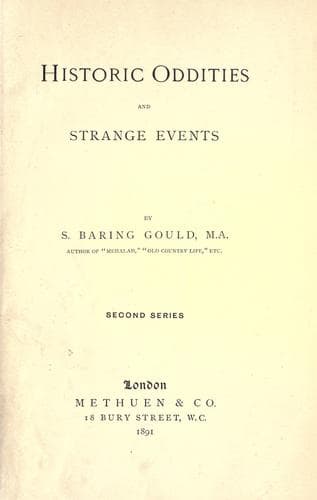
Historic Oddities and Strange EventsBaring-Gould, S. (Sabine)
History
Historic Oddities and Strange Events
Baring-Gould, S. (Sabine)
History; Mysticism; Patarines
Such was the confession of Stauff. How far true, it is impossible to
say. He said nothing about the bell-pull being torn down, nothing about
the holes burnt in the sofa of the sitting-room. According to the
opinion of some experimentalists, the way in which he pretended to have
burnt the Countess would not account for the appearance of the corpse.
His object was to represent himself as the victim of an over-mastering
temptation--to show that the crime was wholly unpremeditated.
This was the sole plea on which he could appeal for sympathy, and expect
a relaxation of his sentence.
That sentence was relaxed.
In 1872 he obtained a free pardon from the Grand-Duke, on condition that
he left the country and settled in America. Including his imprisonment
before his trial, he had, therefore, undergone twenty-five years of
incarceration.
When released he went to America, where he probably still is.
A War-and-Honey-Moon.
In the history of Selenography, John Henry Maedler holds a distinguished
place. He was the very first to publish a large map of the lunar
surface; and his map was a good one, very accurate, and beautifully
executed, in four sheets (1834-6). For elucidation of this map he wrote
a book concerning the moon, entitled "The Universal Selenography." Not
content with this, he published a second map of the moon in 1837,
embodying fresh discoveries. Indeed as an astronomer, Maedler was a
specialist. Lord Dufferin when in Iceland met a German naturalist who
had gone to that inclement island to look for one moth. It is of the
nature of Teutonic scientific men not to diffuse their interests over
many branches of natural history or other pursuits, but to focus them on
a single point. Maedler was comparatively indifferent to the planets,
cold towards the comets, and callous to the attractions of the nebulæ.
On the subject of the moon, he was a sheer lunatic.
He died at Hanover in 1874 at the age of eighty, a moon gazer to the
last. Indeed, he appeared before the public as the historian of that
science in a work published at Brunswick, the year previous to his
death. The study of astronomy, more than any other,--even than
theology--detaches a man from the world and its interests. Indeed
theology as a study has a tendency to ruffle a man, and make him bark
and snap at his fellow men who use other telescopes than himself; it is
not so with astronomy. This science exercises a soothing influence on
those who make it their study, so that an Adams and a Le Verrier can
simultaneously discover a Neptune without flying at each other's noses.
Public-domain text, read in full here on John Shaqi.
Reviews
Reviews
No reviews yet
Be the first to share your thoughts on this work.
Elsewhere in the archive
Join the Discussion
Join the discussion
Sign in to leave a comment or review.
Sign InorCreate an account