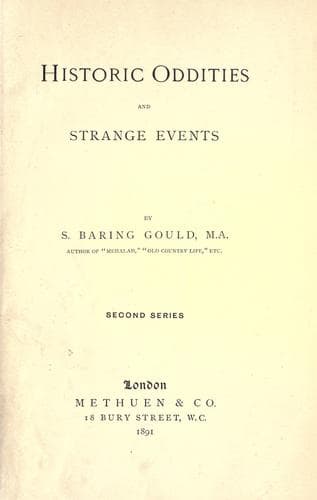
Historic Oddities and Strange EventsBaring-Gould, S. (Sabine)
History
Historic Oddities and Strange Events
Baring-Gould, S. (Sabine)
History; Mysticism; Patarines
Germany, to the present day, abounds in vast and magnificent palaces,
for the most part in wretched repair, if not ruinous. The houses of our
English nobility are nothing as compared in size with these palaces of
petty princes, counts, and barons.
To build these mansions, and when built to fill them with officials and
servants, to keep up their armies, and to satisfy the greed of their
mistresses, these German princes needed a good deal of money, and were
ready to show favour to any man who could help them to obtain it--show
where to bore to tap fresh financial springs. All kinds of new methods
of taxation were had recourse to, arousing the bitter mockery of the
oppressed. The tobacco monopoly was called the nose-tax; it was felt to
be oppressive only by the snuff-takers and smokers; and perhaps the
stamp on paper only by those who wrote; but the boot and shoe stamp
imposed by one of the little princes touched everyone but those who went
barefoot.
Joseph Suess introduced the stamp on paper into the palatinate. He did
not invent this duty, which had been imposed elsewhere; but he obtained
the concession of the impost, and sold it to a subfactor for 12,000
florins, and with the money invested in a speculation in the coinage of
Hesse-Darmstadt. All the little German princes at this time had their
own coinage, down to trumpery little states of a few miles in diameter,
as Waldeck, Fulda, Hechingen, and Montfort; and Germany was full to
overflow of bad money, and barren of gold and silver. Suess, in his
peregrinations, had obtained a thorough insight into the mysteries of
this branch of business. He not only thoroughly understood the practical
part of the matter--the coinage--but also where the cheapest markets
were, in which to purchase the metals to be coined. Now that he had some
money at his command, he undertook to farm the coinage of
Hesse-Darmstadt; but almost immediately undersold it, with a profit to
himself of 9,000 florins. He took other contracts for the courts, and
soon realised a comfortable fortune. Even the Archbishop of Cologne
called in his aid, and contributed to enrich him, in his efforts to get
a little more for himself out of the subjects of his palatinate. In the
summer of 1732 Joseph Suess visited the Blackforest baths of Wildbad,
for the sake of the waters. At the same time Charles Alexander of
Würtemberg and his wife were also undergoing the same cure. Oppenheim's
pleasant manners, his handsome face, and his cleverness caught the fancy
of Charles Alexander, and he appointed him his agent and steward; and as
the Prince was then in want of money, Suess lent him a trifle of 2,000
florins. Charles Alexander had not at this time any assurance that he
would ascend the ducal throne of Würtemberg, though it was probable.[18]
The reigning Duke, Eberhardt Louis, had, indeed, just lost his only son;
but it was not impossible that a posthumous grandson might be born.
Charles Alexander was first-cousin of the Duke.
Public-domain text, read in full here on John Shaqi.
Reviews
Reviews
No reviews yet
Be the first to share your thoughts on this work.
Elsewhere in the archive
Join the Discussion
Join the discussion
Sign in to leave a comment or review.
Sign InorCreate an account