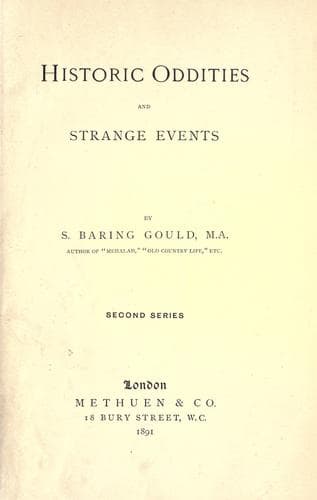
Historic Oddities and Strange EventsBaring-Gould, S. (Sabine)
History
Historic Oddities and Strange Events
Baring-Gould, S. (Sabine)
History; Mysticism; Patarines
Würtemberg enjoyed a constitution more liberal than any other German
principality. The old Duke Eberhardt with the Beard, who died in 1496,
by his will contrived for the good government of his land by providing
checks against despotic rule by the dukes his successors. On the
strength of this testament the Estates deposed his successor. The
provisions of this will were ratified in the Capitulation of Tübingen,
in 1514, and every duke on assuming the reins of government was required
to swear to observe the capitulation. Duke Charles Alexander took the
oath without perhaps very closely examining it, and found out after it
was taken that he was hampered in various ways, and was incapacitated
from raising the body of men with which he had undertaken to furnish the
Emperor, independent of the consent of the Parliament. It may here be
said that there was no hereditary house of nobles in Würtemberg; the
policy of the former dukes had been to drive the hereditary petty
nobles out of the country, and to create in their place a clique of
court officials absolutely dependent on themselves. By the constitution,
no standing army was to be maintained, and no troops raised without the
consent of the Estates; the tenure of property was guaranteed by the
State, all serfage was abolished, and no taxes could be imposed or
monopolies created without the consent of the Estates.
The Estates consisted of fourteen prelates, pastors invested with
dignities which entitled them to sit in the House, and seventy
deputies--some elected by the constituencies, others holders of certain
offices, who sat _ex officio_. The Estates had great power; indeed the
Duke could do little but ask its consent to the measures he proposed,
and to swallow humble pie at refusal. It not only imposed the taxes, but
the collectors were directly responsible to the Estates for what was
collected, and paid into its hands the sum gathered. Moreover, any
agreement entered into between the Duke and another prince was invalid
unless ratified by the Estates.
When Duke Charles Alexander, who had been accustomed to the despotic
command of an army as field-marshal, found how his hands were tied and
how he was surrounded by impediments to free action on all sides, he was
very angry, and quarrelled with the Ministers who had presented the
capitulation to him for signature. He declared that the paper presented
for him to sign had not been read to him in full, or had the obnoxious
passages folded under that he should not see them, or that they had been
added after his signature had been affixed.
He became irritable, not knowing how to keep his promise with the
Emperor, and disgusted to find himself a ruler without real authority.
Now, as it was inconvenient to call the Assembly together on every
occasion when something was wanted, a permanent committee sat in
Stuttgart, consisting of two parts. This committee acted for the Estates
and were responsible to it.
Public-domain text, read in full here on John Shaqi.
Reviews
Reviews
No reviews yet
Be the first to share your thoughts on this work.
Elsewhere in the archive
Join the Discussion
Join the discussion
Sign in to leave a comment or review.
Sign InorCreate an account