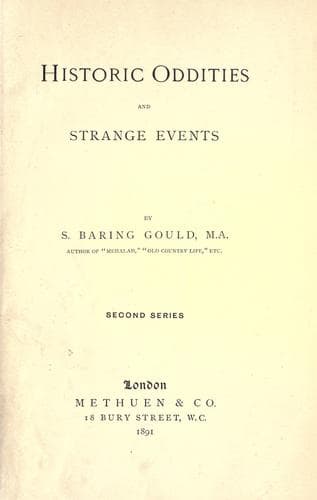
Historic Oddities and Strange EventsBaring-Gould, S. (Sabine)
History
Historic Oddities and Strange Events
Baring-Gould, S. (Sabine)
History; Mysticism; Patarines
Suess had constituted himself jeweller to the Duke, who had a fancy for
precious stones, but knew nothing of their relative values. When Suess
offered him a jewel he was unable to resist the temptation of buying it,
and very little of the money of the Bureau of Gratuities ever reached
him; he took the value out in stones at Suess' estimation. When some of
his intimates ventured to suggest that the Jew was deceiving him as to
the worth of the stones, Duke Charles Alexander shrugged his shoulders
and said with a laugh, "It may be so, but I can't do without that
coujon" (_cochon_).[19] . At the beginning of 1736 a new edict for wards
was issued by the Duke, probably on Suess' suggestion, whereby he
constituted a chancery which should act as guardian to all orphans under
age, managing their property for them, and was accountable to none but
the Duke for the way in which it dealt with the trust. Then a commission
was instituted to take charge of all charitable bequests in the duchy;
and by this means Suess got the fingering of property to the amount of
two hundred thousand pounds, for which the State paid to the Charities
at the rate of three per cent.
Then came the imposition of duties and taxes. Salt was taxed,
playing-cards, groceries, leather, tobacco, carriages, even the sweeping
of chimneys. A gazette was issued containing decrees of the Duke and
official appointments, and every officer and holder of any place,
however insignificant, under Government was compelled to subscribe to
this weekly paper, the profits of which came to the Duke and his
adviser. Then came a property and income tax; then in quick succession
one tormenting edict after another, irritating and disturbing the
people, and all meaning one thing--money.
Lotteries were established by order of the Duke. Suess paid the Duke
£300 for one, and pocketed the profits, which were considerable. At the
court balls and masquerades Suess had his roulette tables in an
adjoining room, and what fell to the _croupier_ went into his
pocket.[20]
At last his sun declined. The Duke became more and more engrossed in his
ideas of upsetting the constitution by means of his army, and listened
more to his general, Remchingen, than to Suess. He entered into a
compact with the elector of Bavaria and with the Bishops of Würzburg and
Bamberg to send him troops to assist him in his great project, and, as a
price for this assistance, promised to introduce the Roman Catholic
religion into Würtemberg.
Public-domain text, read in full here on John Shaqi.
Reviews
Reviews
No reviews yet
Be the first to share your thoughts on this work.
Elsewhere in the archive
Join the Discussion
Join the discussion
Sign in to leave a comment or review.
Sign InorCreate an account