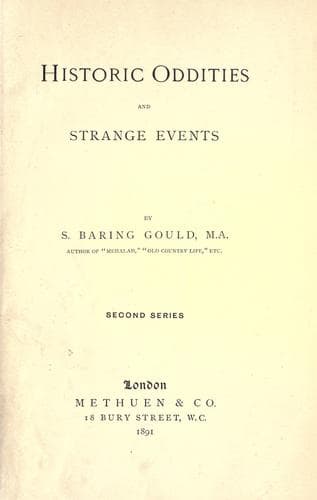
Historic Oddities and Strange EventsBaring-Gould, S. (Sabine)
History
Historic Oddities and Strange Events
Baring-Gould, S. (Sabine)
History; Mysticism; Patarines
In 1776 he was removed to Schwächat to go through a course of Moral
Theology. His disgust at his enforced studies, which he regarded as the
thrashing of empty husks, increased. He was angry at his removal from
the friends he had made at Wardein. Vexation, irritation, doubt, threw
him into a fever, and he was transferred to the convent in the suburbs
of Vienna, where he could be under better medical care. The physician
who attended him soon saw that his patient's malady was mental. Fessler
opened his heart to him, and begged for the loan of books more feeding
to the brain than the mystical rubbish in the convent library. The
doctor advised him to visit him, when discharged as cured from the
convent infirmary, instead of at once returning to Schwächat. This he
did, and the doctor introduced him to two men of eminence and influence,
Von Eybel and the prelate Rautenstrauch, a Benedictine abbot, the
director of the Theological Faculties in the Austrian Monarchy. This
latter promised Fessler to assist him in his studies, and urged him to
study Greek and Hebrew, also to widen the circle of his reading, to make
acquaintance with law, history, with natural science and geography, and
undertook to provide him with the requisite books.
On his return to Schwächat, Fessler appealed to the Provincial against
his Master of Studies whom he pronounced to be an incompetent pedant. At
his request he was moved to Wiener-Neustadt. There he found the lecturer
on Ecclesiastical Studies as superficial as the man from whom he had
escaped. This man did not object to Fessler pursuing his Greek and
Hebrew studies, nor to his taking from the library what books he liked.
The young candidate now borrowed and devoured deistical works, Hobbes,
Tindal, Edelmann, and the Wolfenbüttel Fragments. He had to be careful
not to let these books be seen, accordingly he hid them under the floor
in the choir. After midnight, when matins had been sung, instead of
returning to bed with the rest, he remained, on the plea of devotion, in
the church, seated on the altar steps, reading deistical works by the
light of the sanctuary lamp, which he pulled down to a proper level. He
now completely lost his faith, not in Christianity only, but in natural
religion as well. Nevertheless, he did not desist from his purpose of
seeking orders. He was ordained deacon in 1778, and priest in 1779. "On
the Sunday after Corpus Christi, I celebrated without faith, without
unction, my first mass, in the presence of my mother, her brother, and
the rest of my family. They all received the communion from my hand,
bathed in tears of emotion. I, who administered to them, was frozen in
unbelief."
Public-domain text, read in full here on John Shaqi.
Reviews
Reviews
No reviews yet
Be the first to share your thoughts on this work.
Elsewhere in the archive
Join the Discussion
Join the discussion
Sign in to leave a comment or review.
Sign InorCreate an account