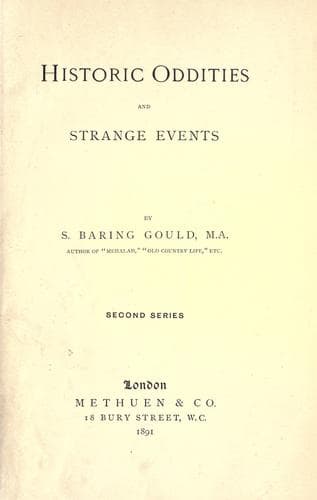
Historic Oddities and Strange EventsBaring-Gould, S. (Sabine)
History
Historic Oddities and Strange Events
Baring-Gould, S. (Sabine)
History; Mysticism; Patarines
Fessler, after his escape from Austria, became a salaried reader and
secretary to the Count of Carolath, whose wife was a princess of
Saxe-Meiningen.
After a while he married a young woman of the middle class; he seems to
have doubted whether they would be happy together, after he had
proposed, accordingly he wrote her a long epistle, in the most pedantic
and dictorial style, informing her of what his requirements were, and
warning her to withdraw from the contemplated union, if she were not
sure she would come up to the level of the perfect wife. The poor
creature no doubt wondered at the marvellous love letter, but had no
hesitation in saying she would do her duty up to her lights. The result
was not happy. They led together a cat-and-dog life for ten years. She
was a homely person without intellectual parts, and he was essentially a
book-worm. He admits that he did not shine in society, and leaves it to
be understood that the loss was on the side of inappreciative society,
but we can not help suspecting that he was opinionated, sour, and
uncouth. All these qualities were intensified in the narrow circle of
home. After ten years of misery he divorced his wife on the ground of
mutual incompatibility. For a livelihood he took up Freemasonry, and
went about founding lodges. There were three rogues at that period who
worked Freemasonry for their own ends, the Darmstadt Court Chaplain,
Starck, a Baron von Hundt, and a certain Becker, who called himself
Johnson, and pretended to be a delegate from the mysterious, unknown
head of the Society in Aberdeen. They called themselves Masons of the
Strict Observance, but were mere swindlers.
After a while, Freemasonry lost its attractions for Fessler, probably it
ceased to pay, and then he left Breslau, and wandered into Prussia. He
wrote a novel called "Marcus Aurelius," glorifying that emperor, for
whom he entertained great veneration, and did other literary work, which
brought him in a little money. Then he married again, a young, beautiful
and gifted woman, with a small property. He was very happy in his
choice, but less happy in the speculation in which he invested her money
and that of her sisters. It failed, and they were reduced to extreme
poverty. What became of the sisters we do not know. Fessler with his
wife and children went into Russia, and sponged for some time on the
Moravian Brothers, who treated him with great kindness, and lent him
money, "Which," he says, in his autobiography, "I have not yet been able
to pay back altogether."
Public-domain text, read in full here on John Shaqi.
Reviews
Reviews
No reviews yet
Be the first to share your thoughts on this work.
Elsewhere in the archive
Join the Discussion
Join the discussion
Sign in to leave a comment or review.
Sign InorCreate an account