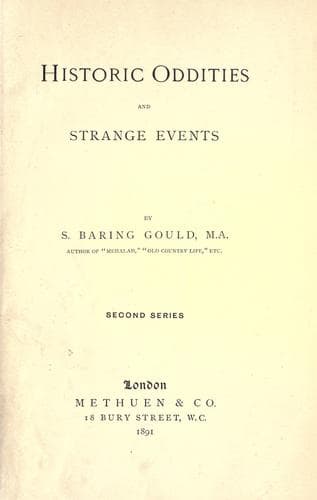
Historic Oddities and Strange EventsBaring-Gould, S. (Sabine)
History
Historic Oddities and Strange Events
Baring-Gould, S. (Sabine)
History; Mysticism; Patarines
In the reign of Heraclius, when Sergius was patriarch of Constantinople,
there lived in Byzantium a merchant named Theodore, a good man and just,
fearing God, and serving him with all his heart. He went on a voyage to
the ports of Syria and Palestine with his wares, in a large well-laden
vessel, sold his goods to profit, and turned his ship's head homewards
with a good lading of silks and spices, the former some of the produce
of the looms of distant China, brought in caravans through Persia and
Syria to the emporiums on the Mediterranean.
It was late in the year when Theodore began his voyage home, the
equinoctial gales had begun to blow, and prudence would have suggested
that he should winter in Cyprus; but he was eager to return to Byzantium
to his beloved wife, and to prepare for another adventure in the ensuing
spring.
But he was overtaken by a storm as he was sailing up the Propontis, and
to save the vessel he was obliged to throw all the lading overboard. He
reached Constantinople in safety, but with the loss of his goods. His
grief and despair were excessive. His wife was unable to console him. He
declared that he was weary of the world, his loss was sent him as a
warning from heaven not to set his heart on Mammon, and that he was
resolved to enter a monastery, and spend the rest of his days in
devotion.
"Hasten, husband mine," said the wife, "put this scheme into execution
at once; for if you delay you may change your mind."
The manifest impatience of his wife to get rid of him somewhat cooled
the ardour of Theodore for the monastic profession, and before taking
the irrevocable step, he consulted a friend. "I think, dearest brother,
nay, I am certain, that this misfortune came on me as the indication of
the finger of Providence that I should give up merchandise and care only
for the saving of my soul."
"My friend," answered the other, "I do not see this in the same light as
you. Every merchant must expect loss. It is one of the ordinary risks of
sailors. It is absurd to despair. Go to your friends and borrow of them
sufficient to load your vessel again, and try your luck once more. You
are known as a merchant, and trusted as an honest man, and will have no
difficulty in raising the sum requisite."
Theodore rushed home, and announced to his wife that he had already
changed his mind, and that he was going to borrow money.
"Whatever pleases you is right in my eyes," said the lady.
Public-domain text, read in full here on John Shaqi.
Reviews
Reviews
No reviews yet
Be the first to share your thoughts on this work.
Join the Discussion
Join the discussion
Sign in to leave a comment or review.
Sign InorCreate an account