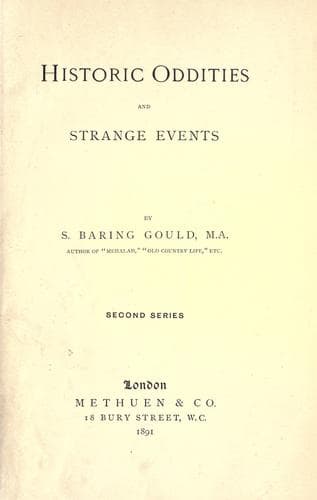
Historic Oddities and Strange EventsBaring-Gould, S. (Sabine)
History
Historic Oddities and Strange Events
Baring-Gould, S. (Sabine)
History; Mysticism; Patarines
"Not even a cow!" exclaimed the Canon. "I really am thankful for your
having spoken so plainly to me. I had no conception that your cure was
so poor. That the Archdeacon should not have fulfilled the promises he
made you is due to forgetfulness. Indeed, I assure you, for the last
five years I have repeatedly seen Hartwig Juel strike his brow and
exclaim, 'Something troubles me. I have made a promise, and cannot
recall it. This lies on my conscience, and I shall have no peace till I
recollect and discharge it.' This is plain fact."
"Take him a handful of carraway," urged the parish priest.
"No--he will remember all when I speak to him, unaided by carraway."
"There is one thing I can offer you," said Peter Nielsen, "a mug of
dill-water."
"Dill-water! what is that?"
"It is made from carraway. It is given to infants to enable them to
retain their milk. It is good for adults to make them recollect their
promises."
"My dear good friend," said the Canon rising, "your requirements shall
be complied with to-morrow. I see you have excellent pasture here for
sheep. Have you any?"
The parish priest shook his head.
"That is a pity. That however can be rectified. Good-bye, rely on me.
_Qui pacem habet, se primum pacat._"
When the Canon was gone, Peter Nielsen, who had attended him to the
door, turned, and found Maren Grubbe behind him.
"I say, Peers!" spoke the housekeeper, nudging him, "What is the meaning
of all this? What was that Latin he said as he went away?"
"My dear, good Maren," answered the priest, "he quoted a saying
familiar to us clergy. At the altar is a little metal plate with a cross
on it, and this is called the Pax, or Peace. During the mass the priest
kisses it, and then hands it to his assistant, who kisses it in turn and
passes it on so throughout the attendance. The Latin means this, 'Let
him who has the Pax bless himself with it before giving it out of his
hands,' and means nothing more than this: 'Charity begins at Home,'
or--put more boldly still, 'Look out for Number I.'"
"Now, see here," said the housekeeper, "you have been too moderate,
Peers, you have not looked out sufficiently for Number I. Leave the next
comer to me. No doubt that the Dean will send to you, in like manner as
the Archdeacon sent to-day."
"As you like, Maren, but keep the children in the background. Charity
that thinketh no ill, is an uncommon virtue."
Next morning early there arrived at the parsonage a waggon laden with
sides of bacon, smoked beef, a hogshead of prime ale, a barrel of
claret, and several sacks of wheat. It had scarcely been unloaded when a
couple of milch cows arrived; half an hour later came a drove of sheep.
Peter Nielsen disposed of everything satisfactorily about the house and
glebe. His eye twinkled, he rubbed his hands, and said to himself with a
chuckle, "He who blesses, blesses first himself."
Public-domain text, read in full here on John Shaqi.
Reviews
Reviews
No reviews yet
Be the first to share your thoughts on this work.
Elsewhere in the archive
Join the Discussion
Join the discussion
Sign in to leave a comment or review.
Sign InorCreate an account