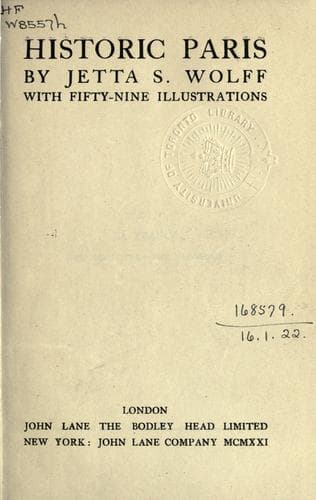
Paris (France) -- Description and travel; Paris (France) -- History
Rue des Martyrs, named in memory of the Christian missionaries who
passed there to their death, so called in its whole length only since
1868, has ever been the habitation of artists. We see few interesting
vestiges. From 1872 it has been a market street. Costermongers’ carts
line it from end to end several days a week. The restaurant de la Biche
at No. 37 claims to date from 1662. The once-famous restaurant du Faisan
Doré was at No. 7. The short streets opening out of this long one date
for the most part from the early years of the nineteenth century and
form, with the longer ones of the district, the Paris artists’ quarter.
Rue de la Tour d’Auvergne records the name of an abbess of Montmartre.
Victor Hugo lived at No. 41 at the time of the _coup d’état_, fled
thence to exile in England. The school at No. 31 is on the site of
gardens once hired for the children of the duc d’Orléans, the pupils of
Mme de Genlis, to play in, then owned by Alphonse Karr. We see at No. 14
a charming statue “Le joueur de flute.”
Rue Rochechouart records the name of another abbess. At No. 7, now a
printing house, abbé Loyson gave his lectures. Rue Cadet, formerly Rue
de la Voirie, records the name of a family of gardeners, owners of the
Clos Cadet, from the time of Charles IX. Nos. 9, 16, 24 are
eighteenth-century structures. Rue Richer was known in the earlier years
of the eighteenth century as Rue de l’Égout. Augustin Thierry lived here
for two years (1831-33). No. 18 was the office of the modern
revolutionary paper _La Lanterne_. Marshal Ney lived at the _hôtel_
numbered 13. The Folies Bergères at No. 32 was built in 1865 on the site
of the _hôtel_ of comte Talleyrand-Périgord. In Rue Saulnier, recording
the name of another famous family of gardeners, we see at No. 21 the
house once inhabited by Rouget de Lisle, composer of the “Marseillaise.”
Rue Bergère was in seventeenth-century days an _impasse_. Casimir
Delavigne lived at No. 5. Scribe in his youth at No. 7, in later life at
a _hôtel_ on the site of No. 20, which was in eighteenth-century days
the home of M. d’Étiolles, the husband of La Pompadour. The Comptoir
d’Escompte at No. 14 was built in 1848, on the site of several old
_hôtels_, notably hôtel St-Georges, the home of the marquis de Mirabeau,
father of the orator.
Public-domain text, read in full here on John Shaqi.
Reviews
Reviews
No reviews yet
Be the first to share your thoughts on this work.
Elsewhere in the archive
Join the Discussion
Join the discussion
Sign in to leave a comment or review.
Sign InorCreate an account