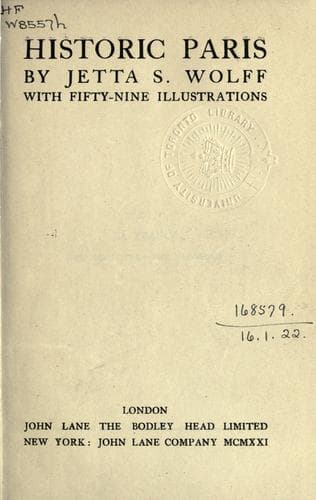
Paris (France) -- Description and travel; Paris (France) -- History
Let us start from the Point-du-Jour, the “Dawn of Day,” at the point
where the boundary-line of Paris touches the _banlieue_ to the
south-east. The name refers to a famous duel fought here at the break of
day on a memorable morning in 1743. Taking the Rive Droite, the right
bank, we follow the Quai d’Auteuil which, till the closing years of the
nineteenth century, was a mere roadway along which the river boats were
loaded and unloaded. The fine viaduct across the river was built in
1864-65. It was fiercely bombarded in the war of 1870. On Sundays and
fête-days this quaint quay is gay with holiday-makers who crowd its
popular cafés, drinking-booths and shows.
Quai de Passy was made in 1842 along that part of the old high road to
Versailles. Some quaint old houses still stand there. At No. 26 we see a
pavilion Louis XVI. No 32 is surrounded by a fine park wherein we find
vestiges of the home of the abbé Ragois, Madame de Maintenon’s
confessor, and ferruginous springs. Rue Berton, leading up from the
Quai, is one of the most picturesque old streets of Paris. At No. 17 we
find an extensive property and a Louis XV _hôtel_, once the home of
successive families of the _noblesse_ and of the unhappy princesse de
Lamballe, now a Maison de Santé--a private asylum. The _borne_ at No. 24
has been there since 1731, a boundary mark between the manors of Passy
and Auteuil.
Quai de la Conférence, arrondissement VIII, dates from the latter years
of the eighteenth century, its name referring to the middle of the
previous century, when Spanish statesmen entered Paris by a great gate
in its vicinity to confer concerning the marriage of Louis XIV and
Marie-Thérèse.
Cours-la-Reine, bordering the Seine along this quay, was first planted
by Marie de’ Medici in 1618, on market-garden ground. It was a favourite
and fashionable promenade in the time of the Fronde; a moat surrounded
it and iron gates closed it in. At No. 16 of Rue Bayard leading out of
it, we see the Maison de François I, its sculptures the work of Jean
Goujon, brought here, bit by bit, in 1826 from the quaint old village of
Moret near Fontainebleau where it was first built. On its frontage we
read an inscription in Latin.
Public-domain text, read in full here on John Shaqi.
Reviews
Reviews
No reviews yet
Be the first to share your thoughts on this work.
Elsewhere in the archive
Join the Discussion
Join the discussion
Sign in to leave a comment or review.
Sign InorCreate an account