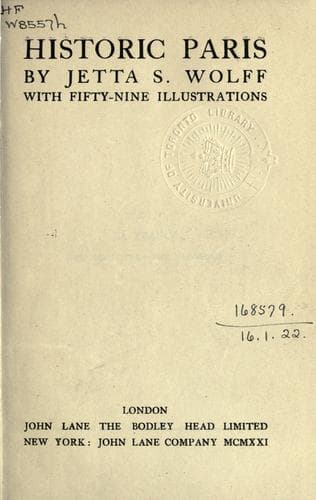
Paris (France) -- Description and travel; Paris (France) -- History
Viarnes, Rue de, 38
Victor-Massé, Rue, 228-9
Vicq d’Aziz, Rue, 319
Victoire, Rue de la, 225-6
Victor-Hugo, Avenue, 264
Vieuville, Rue la, 285
Vieux-Chemin, Rue, 285
Vieux-Colombier, Rue du, 174
Vignes, Rue des, 271-2
Vignon, Rue, 224
Villars, Avenue de, 191
Ville l’Évêque, Rue de la, 210-11
Ville-Neuve, Rue de la, 59
Villedo, Rue, 33
Villette, Boulevard de la, 318-19
Villehardouin, Rue, 84
Villiers, Avenue de, 277
Vineuse, Rue, 268
Visconti, Rue, 171-2
Vivienne, Rue, 51, 54
Voie-Verte, Rue de la, 258
Volney, Rue, 60
Volta, Rue de, 68
Vrillière, Rue la, 24
W
Wagram, Avenue, 216, 221, 277
Washington, Rue, 220
Wilhem, Rue, 274
Wilson, Avenue, 267
Y
Yvon de Villarceau, Rue, 265
Z
Zacharie, Rue, 126, 335
FOOTNOTES:
[A] The pictures have been arranged on a different plan since their
return to the palace after the war.
[B] Part of Rue de Beaubourg, Rue du Renard, and other old streets here
are soon to disappear, their area transformed into a wide new avenue.
[C] Bombs worked havoc here in the last year of the Great War
(1914-1918).
[D] The carting away of these vestiges has, we hear, just been decreed.
[E] On the Peace Fête, July 14th, 1919, the Arènes were arranged
as a theatre, and the performance of a classical play, “Le Cid,”
took place on the spot where wild beasts had fought of yore; while
twentieth-century Frenchmen sat on the very stone seats whereon had sat
Romans and men of primitive Gallic tribes in the earliest days of the
history of Paris and of France.
[F] On July 14th, 1919, the French Army and contingents from the armies
of the Allies, victorious after the dread war which had raged since
August, 1914, passed in triumphal procession beneath the Arch, and
the chains which, since 1871, had barred its passage, were taken away
for good. On November 11th, when the “unknown soldier” was buried in
Westminster Abbey, the “_poilu inconnu_” was laid beneath the Arc de
Triomphe, and is now buried there.
[G] Le comte de Franqueville died in January, 1920.
[H] It was flooded again in 1920.
[I] It was recently demolished to be replaced by a suspension-bridge in
order to leave the river free for navigation.
* * * * *
Typographical errors corrected by the etext transcriber:
here in invitation of the Rotonde=> here in imitation of the Rotonde {pg
270}
Demoulins=> Desmoulins {pg 17}
King Jerôme=> King Jérôme {pg 17}
Sebastopol=> Sébastopol {pg 42}
Sophie Arnoult=> Sophie Arnould {pg 60}
Rue Jean-de-Beauvias=> Rue Jean-de-Beauvais {pg 140}
Aqueduc d’Arcueil brought water from Rangis=> Aqueduc d’Arcueil brought
water from Rungis {pg 152}
Rue de l’Abbé-de-l’Epée=> Rue de l’Abbé-de-l’Épée {pg 153}
restauraunt Lapérouse => restaurant Lapérouse {pg 180}
days of unparalled warfare=> days of unparalleled warfare {pg 190}
cut if off from surrounding buildings=> cut it off from surrounding
buildings {pg 218}
St-Marguerite=> Ste-Marguerite {pg 245}
Public-domain text, read in full here on John Shaqi.
Reviews
Reviews
No reviews yet
Be the first to share your thoughts on this work.
Elsewhere in the archive
Join the Discussion
Join the discussion
Sign in to leave a comment or review.
Sign InorCreate an account