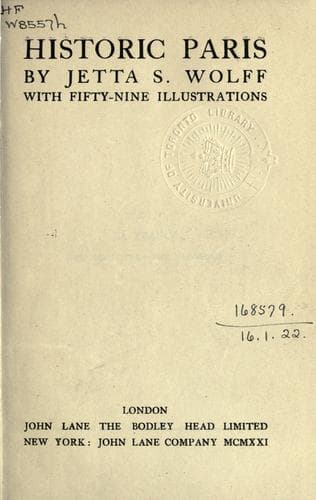
Paris (France) -- Description and travel; Paris (France) -- History
It was in the early years of the seventeenth century that the King’s
physician bought a piece of waste ground--a _butte_ formed of the refuse
of centuries accumulated there--for the culture of the multitudinous
herbs and plants which made up the pharmacopia of the age. Thus was born
the “Jardin Royal de herbes médicinales” laid out in 1626. Chairs of
botany, pharmacy, surgery were instituted and endowed, and in 1650 the
garden was thrown open to the public. A century later Buffon was named
superintendent of the royal garden. He set himself to reorganize and
enlarge. The amphitheatre, the natural history galleries, the chemistry
laboratories, the fine lime-tree avenue are all due to him.
Distinguished naturalists succeeded one another as directors of the
garden, and after the death of Louis XVI a museum of natural history and
a menagerie were set up with what was left of the King’s collection at
Versailles. Additions and improvements were made in succeeding years
till, after the outbreak of war in 1870, the Jardin was bombarded by the
Prussians, and during the siege its live-stock largely drawn upon to
feed the population of Paris. The garden and its buildings have been
added to frequently. The labyrinth is on the site of the hillock bought
by Guy de la Brosse, who first laid it out. A granite statue marks the
spot where he and two notable travellers were buried. Surrounding
streets record the names of great naturalists of different epochs.
In Rue Geoffroy St-Hilaire, once Rue Jardin du Roi, No. 5, now the
Police Station, was built in 1760. At No. 30 a wheel once worked turned
by the water of the Bièvre, now a malodorous drain-stream hidden beneath
the pavement. No. 36 was Buffon’s home. Here he died in 1788. At No. 37
lived Daubenton. At No. 38 stood in olden days the great gate, the
Porte-Royale, of the Jardin du Roi, with to its left the hall, a narrow
space at that time, where the great surgeon Dionis described to a
marvelling assembly of students his wonderful discoveries (1672-73).
That small _cabinet_ was the nucleus of the great anthropological museum
of succeeding centuries.
In Rue Cuvier, in its early days Rue Derrière-les-Murs de Ste-Victoire,
describing accurately its situation, we see at No. 20 a modern fountain
(1840) on the site of one put there in 1671 and traces of the abbey
St-Victor in the courtyard. The pavilion “de l’Administration” of the
Garden is the ancient hôtel Jean Debray (1650), inhabited subsequently
by several men of note. At No. 47 Cuvier died in 1832. In the
eighteenth-century _fiacres_, a recently introduced manner of getting
about, were to be hired at No. 45. The eleventh-century Rue Linné shows
many vestiges of the past. We see Gothic arches of the vanished abbey at
No. 4.
Public-domain text, read in full here on John Shaqi.
Reviews
Reviews
No reviews yet
Be the first to share your thoughts on this work.
Elsewhere in the archive
Join the Discussion
Join the discussion
Sign in to leave a comment or review.
Sign InorCreate an account