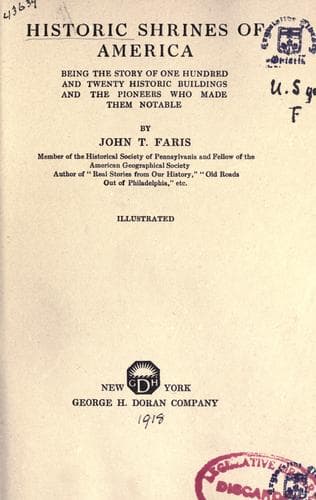
Historic Shrines of America: Being the Story of One Hundred and Twenty Historic Buildings and the Pioneers Who Made Them NotableFaris, John T. (John Thomson)
History
Historic Shrines of America: Being the Story of One Hundred and Twenty Historic Buildings and the Pioneers Who Made Them Notable
Faris, John T. (John Thomson)
Historic buildings -- United States; United States -- Biography
The chapel of the Gemeinhaus was used by the congregation for nine
years. During this period many of the Indians were baptised there. In
1752 and again in 1753 councils were held here with the
representatives of the Nanticoke and Shawnee Indians from the Wyoming
Valley.
The second place of worship was an extension of the Gemeinhaus,
completed in 1751. Here congregations gathered for fifty-five years.
Here the gospel was preached by some of the most eminent ministers of
colonial days, while the records show that famous visitors sat in the
pews. Among them were Governor John Penn; Generals Washington,
Amherst, Gage, Gates, and Lafayette; John Hancock, Henry Laurence,
Samuel and John Adams, Richard Henry Lee, and many other delegates to
the Continental Congress.
During the Revolution there were no more earnest patriots than the
members of the Moravian Community at Bethlehem. At one time the Single
Brethren's House was used for eight months as a hospital, and no
charge was made, though in 1779 a bill for repairs was sent which
amounted to $358.
A letter from David Rittenhouse, received on September 16, 1778,
caused great excitement, for he told of the despatch to Bethlehem of
all the military stores of Washington's army, carried in seven hundred
wagons. This was done because Washington's army had been compelled to
fall back on Philadelphia. It was also thought wise to send the bells
of Christ Church and of Independence Hall to Allentown, by way of
Bethlehem. The wagon on which Independence Bell was loaded broke down
on descending the hill in front of the hospital, and had to be
unloaded while repairs were being made.
The most distinguished patient cared for in Bethlehem was the Marquis
de Lafayette, who was brought from Brandywine, and was nursed by
Sister Liesel Beckel.
Twenty years after the close of the war it was decided that the time
had come for the building of a permanent church. The first estimate
was made in 1802. At that time it was thought that the total cost
would be $11,000. "It is interesting to note how very modern they were
in underestimating the probable cost of a church," Bishop Levering
says. The actual cost, including the organ, was more than five times
the estimate.
The excavation for the building was made in March, 1803, by volunteer
laborers, to whom the residents of the Sisters' House furnished lunch.
The work was completed in two weeks. Then the great foundation walls
were laid, six feet thick.
For the services of consecration, held from May 18 to May 26, 1806,
six thousand people gathered in the village of five hundred
inhabitants. On the first day, "at five o'clock in the morning the
jubilant note of trombones, trumpets, and other wind instruments from
the belfry of the church broke the stillness of the awaking village
with a musical announcement of the festival day."
Public-domain text, read in full here on John Shaqi.
Reviews
Reviews
No reviews yet
Be the first to share your thoughts on this work.
Elsewhere in the archive
Join the Discussion
Join the discussion
Sign in to leave a comment or review.
Sign InorCreate an account