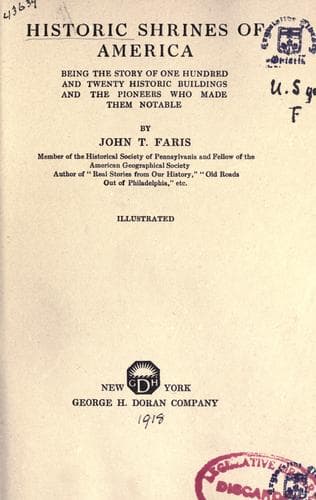
Historic Shrines of America: Being the Story of One Hundred and Twenty Historic Buildings and the Pioneers Who Made Them NotableFaris, John T. (John Thomson)
History
Historic Shrines of America: Being the Story of One Hundred and Twenty Historic Buildings and the Pioneers Who Made Them Notable
Faris, John T. (John Thomson)
Historic buildings -- United States; United States -- Biography
Many of the buildings and traditions centre about the old Market
Square, in the centre of the town, only a few hundred feet from the
Delaware. This square dates from the days of Petrus Stuyvesant, in
1658. At one end of the square is the old stone-paved courthouse,
which has been in use since 1672. To this building William Penn was
welcomed, as a tablet on the outer wall relates:
"On the 28th Day of October, 1682, William Penn, the Great
Proprietor, on His First Landing in America, Here Proclaimed
His Government and Received from the Commissioner of the Duke
of York the Key of the Fort, the Turf, Twig, and Water, as
Symbols of His Possession."
From the steps of the courthouse, as a centre, was surveyed the
twelve-mile circle whose arc was to be the northern line of Delaware,
according to the royal grant made to Penn. This arc forms the curious
circular boundary, unlike any other boundary in the United States.
[Illustration: IMMANUEL CHURCH, NEWCASTLE, DEL.
_Photo by Ph. B. Wallace_
See page 204]
In the rear of the courthouse, though still on the green Market
Square, is old Emmanuel Protestant Episcopal Church, which was
organized in 1689, though the building now occupied was begun in 1703.
This cruciform structure is the oldest church of English building on
the Delaware, and services have been held here continuously since
1706, when it was completed. Queen Anne gave to the church a "Pulpit
and Altar Cloath, with a Box of Glass." A memorial tablet on the wall
tells of the first rector, Rev. George Ross, who came as a missionary
from England in 1703, and served for fifty years. His son, also George
Ross, was one of the Signers of the Declaration of Independence.
His daughter Gertrude married George Read, another of the Signers. The
tomb of George Read is in the rear of the church.
[Illustration: DOORWAY OF PRESBYTERIAN CHURCH, NEW CASTLE, DEL.
_Photo by Ph. B. Wallace_
See page 205]
Across the street from the Market Square is the Presbyterian church,
whose first building, erected in 1707, is still in use as a part of
its ecclesiastical plant. The pastor and many of the members of this
church had a prominent part in the War of the Revolution.
The visitor who crosses from one of these churches to the other is
attracted by a stone pyramid, on the edge of the Market Square, whose
story is told by a tablet:
"These stones were sleepers in the New Castle and Frenchtown
Railroad, completed in 1831, the first railroad in Delaware,
and one of the first in the United States."
[Illustration: DOORWAY OF RODNEY HOUSE, NEW CASTLE, DEL.
_Photo by Ph. B. Wallace_]
[Illustration: DOORWAY OF STEWART HOUSE, NEW CASTLE, DEL.
_Photo by Ph. B. Wallace_]
Public-domain text, read in full here on John Shaqi.
Reviews
Reviews
No reviews yet
Be the first to share your thoughts on this work.
Elsewhere in the archive
Join the Discussion
Join the discussion
Sign in to leave a comment or review.
Sign InorCreate an account