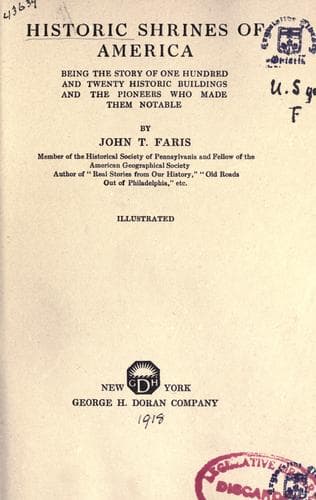
Historic Shrines of America: Being the Story of One Hundred and Twenty Historic Buildings and the Pioneers Who Made Them NotableFaris, John T. (John Thomson)
History
Historic Shrines of America: Being the Story of One Hundred and Twenty Historic Buildings and the Pioneers Who Made Them Notable
Faris, John T. (John Thomson)
Historic buildings -- United States; United States -- Biography
"I sent an express, at my own private expense, for your
honored uncle, the remaining member from Delaware, whom I met
at the State House door, in his boots and spurs, as the
members were assembling. After a friendly salutation, without
a word in the business, we went into the hall of Congress
together, and found we were among the latest. Proceedings
immediately commenced, and after a few minutes the great
question was put. When the vote of Delaware was called, your
uncle arose and said: 'As I believe the voice of my
constituents and of all sensible and honest men is in favor
of independence, and my own judgment coincides with theirs, I
vote for independence.'"
Since Pennsylvania also voted in favor of the Declaration, it was
adopted unanimously.
Caesar Rodney was Governor of Delaware from 1778 to 1781. On April 8,
1784, the State Council, of which he was presiding officer, met at his
house near Dover, because he was too ill to go to Dover. Less than
three months later he died.
A monument marks his last resting-place in Christ Episcopal churchyard
in Dover.
XLVI
REHOBOTH CHURCH ON THE POCOMOKE, MARYLAND
THE FIRST PRESBYTERIAN CHURCH IN AMERICA
The Pocomoke River rises in southern Delaware, forms a part of the
eastern boundary of Somerset County, Maryland, and empties into
Pocomoke Sound, an inlet of Chesapeake Bay. On the banks of this
stream, not far from the mouth, Colonel William Stevens, a native of
Buckinghamshire, England, located in 1665, taking out a patent on what
he called the Rehoboth plantation, the name being chosen from Genesis
26:22. "And he called the name of it Rehoboth. And he said, For now
the Lord hath made room for us, and we shall be fruitful in this
land." When Somerset County was organized he was made Judge of the
County Court. He also became a member of "His Lordship's Councill,"
and was one of the Deputy Lieutenants of the Province.
As the years passed many followed Colonel Stevens to Somerset County,
in search of religious freedom. Scotch, Scotch-Irish, French, and
Quakers were represented in the village that was known at first as
Pocomoke Town, though later it was called Rehoboth. Many of these
settlers were Presbyterians, who had lost their property through
persecution.
In 1672 the Grand Jury, encouraged by Judge Stevens, asked Rev. Robert
Maddux to preach at four points in the county. One of these points was
the plantation house at Rehoboth. The next year George Fox, the
Quaker, was in the community. He also preached in his famous "leather
breeches" at Colonel Stevens' plantation, to a great congregation of
several thousand whites and Indians. A Quaker monthly meeting
followed.
Public-domain text, read in full here on John Shaqi.
Reviews
Reviews
No reviews yet
Be the first to share your thoughts on this work.
Elsewhere in the archive
Join the Discussion
Join the discussion
Sign in to leave a comment or review.
Sign InorCreate an account