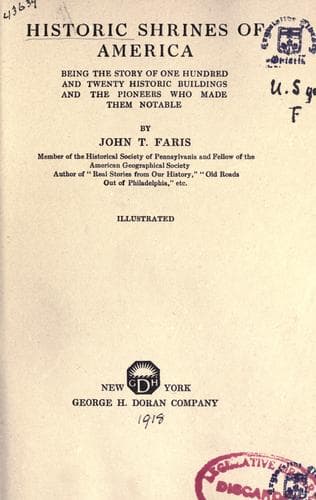
Historic Shrines of America: Being the Story of One Hundred and Twenty Historic Buildings and the Pioneers Who Made Them NotableFaris, John T. (John Thomson)
History
Historic Shrines of America: Being the Story of One Hundred and Twenty Historic Buildings and the Pioneers Who Made Them Notable
Faris, John T. (John Thomson)
Historic buildings -- United States; United States -- Biography
"I arrived here on Sunday last, and without meeting any
accident worth noticing, except losing ourselves when we
left Baltimore, and going eight or nine miles on the
Frederick road, by which means we were obliged to go the
other eight miles through woods, where we wandered for two
hours, without finding a guide, or the path. Fortunately, a
straggling black came up with us, and we engaged him as a
guide to extricate us out of our difficulty; but woods are
all you see, from Baltimore until you reach the city, which
is only so in name. Here and there is a small cot, without a
glass window, interspersed amongst the forests, through which
you travel miles without seeing any human being. In the city
there are buildings enough, if they were compact and
furnished, to accommodate Congress and those attached to it;
but as they are, and scattered as they are, I see no great
comfort for them."
Mrs. Adams found no great comfort in the White House, either. "To
assist us in this great castle," she wrote, "and render less
attendance necessary, bells are wholly wanting, not one single one
being hung through the whole house, and promises are all you can
obtain.... If they will put me up some bells, and let me have wood
enough to keep fires, I design to be pleased.... But, surrounded with
forests, can you believe that wood is not to be had, because people
cannot be found to cut and cart it.... The house is made habitable,
but there is not a single apartment finished.... We have not the least
fence, yard, or other convenience, without, and the great, unfinished
audience-room I make a drying room of, to hang up the clothes in. The
principal stairs are not up, and will not be this winter."
The building itself was in good condition, though the surroundings
were far from prepossessing, when it was burned by the British in
1814. President and Mrs. Madison moved to the Octagon House, and spent
more than a year in this comfortable winter home of Colonel John
Tayloe.
The cost of rebuilding and refurnishing the Executive Mansion was
about three hundred thousand dollars. The work was begun in 1814, and
in September, 1817, the building was so far completed that President
Monroe was able to take up his quarters there in some degree of
comfort, though the floor in the East Room had not yet been laid and
some of the walls were still without plastering. On January 1, 1818,
the first New Year's reception was held there. "It was gratifying to
be able to salute the President of the United States with the
compliments of the season in his appropriate residence," the _National
Intelligencer_ said. It may be added that the editor called the
building "the President's House." The title, "the White House," was
not yet in common use.
Public-domain text, read in full here on John Shaqi.
Reviews
Reviews
No reviews yet
Be the first to share your thoughts on this work.
Elsewhere in the archive
Join the Discussion
Join the discussion
Sign in to leave a comment or review.
Sign InorCreate an account