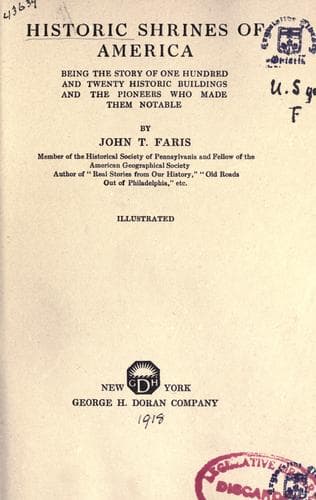
Historic Shrines of America: Being the Story of One Hundred and Twenty Historic Buildings and the Pioneers Who Made Them NotableFaris, John T. (John Thomson)
History
Historic Shrines of America: Being the Story of One Hundred and Twenty Historic Buildings and the Pioneers Who Made Them Notable
Faris, John T. (John Thomson)
Historic buildings -- United States; United States -- Biography
The next stirring period in the history of the Octagon House was the
later years of the second war with Great Britain. On the night of
August 24, 1814, when the British Army entered the city, the French
minister, M. Serurier, looked from his window and saw soldiers
bearing torches going toward the White House. Quickly he sent a
messenger to General Ross and asked that his residence be spared. The
messenger found General Ross in the Blue Room, where he was collecting
furniture for a bonfire. Assured that "the king's house" would be
respected, he returned to the minister.
Dr. Thornton, who was at the time superintendent of the patent office,
succeeded in persuading Colonel Jones to spare that building, on the
ground that it was a museum of the Arts, and that its destruction
would be a loss to all the world.
Among the public buildings destroyed was the White House. Mr. Tayloe
at once offered the Octagon House to President Madison. On September
9, 1814, the _National Intelligencer_ announced, "The President will
occupy Colonel Tayloe's large house, which was lately occupied by the
French minister." For more than a year the house was known as the
Executive Annex.
Rufus Rockwell Wilson, in "Washington, the Capital City," tells how
the mansion looked at this time:
"Its circular entrance hall, marble tiled, was heated by two
picturesque stoves placed in small recesses in the wall.
Another hall beyond opened into a spacious and lovely garden
surrounded by a high brick wall after the English fashion. To
the right was a handsome drawing room with a fine mantel,
before which Mrs. Madison was accustomed to stand to receive
her guests. To the left was a dining-room of equal size and
beauty. A circular room over the hall, with windows to the
floor and a handsome fireplace, was President Madison's
office. Here he received his Cabinet officers and other men
of note, listening to their opinions and reports on the
progress of the war; and here, also, on a quaintly carved
table, he signed, February 18, 1815, the proclamation of the
Treaty of Ghent, which ended the contest with England."
The story of this table's history is interesting. From the Octagon
House it went to John Ogle Ferneaux, of King George County, Virginia.
He kept it until October 30, 1897, when it was sold to Mrs. A. H.
Voorhies, of 2011 California Street, San Francisco. When the fire that
succeeded the earthquake of 1906 approached the house, the table was
taken away hurriedly. Mrs. Voorhies says, "We wrapped sheets around
the circular part of the table, and in part of the journey, it went
turning round as a wheel to a place of safety." The San Francisco
chapter of the Institute of Architects purchased it for $1,000, and
sent it to Washington, December 1, 1911.
Public-domain text, read in full here on John Shaqi.
Reviews
Reviews
No reviews yet
Be the first to share your thoughts on this work.
Elsewhere in the archive
Join the Discussion
Join the discussion
Sign in to leave a comment or review.
Sign InorCreate an account