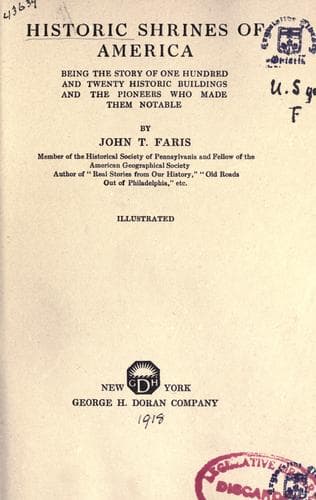
Historic Shrines of America: Being the Story of One Hundred and Twenty Historic Buildings and the Pioneers Who Made Them NotableFaris, John T. (John Thomson)
History
Historic Shrines of America: Being the Story of One Hundred and Twenty Historic Buildings and the Pioneers Who Made Them Notable
Faris, John T. (John Thomson)
Historic buildings -- United States; United States -- Biography
The first property mentioned in connection with the name of Mary Ball,
who became the mother of George Washington, was on the tract of four
hundred acres "in ye freshes of Rappa-h-n River," bequeathed to her in
her father's will before she was six years old. Her father, Colonel
Joseph Ball of Epping Forest, Lancaster County, thought he was about
to die, but he lived some years longer.
Ten years later an unknown writer spoke of Mary Ball in pleasing
terms:
"WmsBurg, ye 7th of Octr, 1722.
"Dear Sukey, Madam Ball of Lancaster and her sweet Molly have
gone Hom. Mama thinks Molly the Comliest Maiden She Knows.
She is about 16 yrs old, is taller than Me, is verry
Sensable, Modest and Loving. Her Hair is like unto Flax, Her
Eyes are the color of Yours, and her Chekes are like May
blossoms. I wish You could see Her."
This "Belle of the Northern Neck," as she came to be called, continued
her conquests of young and old until, at twenty-two, an orphan, she
left Epping Forest to live with her brother, Joseph Ball, at
"Stratford-by-bow, Nigh London." There, on March 6, 1730, she became
the second wife of Augustine Washington, the second son of Laurence
Washington, who was visiting England at the time.
Less than two years later, at Wakefield, on the Potomac, in
Westmoreland County, Virginia, George Washington was born. He was not
three years old when the mansion was burned.
The new home was at Pine Grove, in Stafford County, on the
Rappahannock River, opposite Fredericksburg. For eight years the
family circle was unbroken, but on April 12, 1743, Augustine
Washington died. Laurence Washington, Mary Washington's stepson, then
became the owner of Mt. Vernon, while to George Washington was
bequeathed Pine Grove, though the estate was to be managed by Mrs.
Washington until the son became twenty-one.
With wonderful skill Mrs. Washington directed the plantation and with
firm purpose she devoted herself to the care of her five fatherless
children.
A picture of this capable woman at this period was recorded by
Laurence Washington, a nephew of George Washington's father. He wrote:
"I was often there [at Pine Grove] with George, his playmate,
schoolmate, and young man's companion. Of the mother, I was
more afraid than of my own parents; she awed me in the midst
of her kindness; and even now, when time has whitened my
locks and I am the grandfather of a second generation, I
could not behold that majestic woman without feelings it is
impossible to describe."
The death, in 1752, of Laurence Washington of Mt. Vernon made George
Washington the owner of that property. Thereafter the twenty-five
hundred acre estate became known as the home of the eldest son, while
Mrs. Washington remained at Pine Grove with her younger children.
Public-domain text, read in full here on John Shaqi.
Reviews
Reviews
No reviews yet
Be the first to share your thoughts on this work.
Elsewhere in the archive
Join the Discussion
Join the discussion
Sign in to leave a comment or review.
Sign InorCreate an account