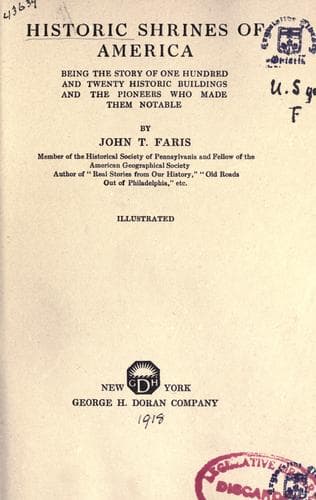
Historic Shrines of America: Being the Story of One Hundred and Twenty Historic Buildings and the Pioneers Who Made Them NotableFaris, John T. (John Thomson)
History
Historic Shrines of America: Being the Story of One Hundred and Twenty Historic Buildings and the Pioneers Who Made Them Notable
Faris, John T. (John Thomson)
Historic buildings -- United States; United States -- Biography
"She was alone, her aged hands employed in the works of
domestic industry, when the good news was announced, and it
was told that the victor was awaiting at the threshold. She
bade him welcome by a warm embrace, and by the
well-remembered and endearing name of George.... She inquired
as to his health, for she marked the lines which mighty cares
and toils had made in his manly countenance, and she spoke
much of old times and old friends, but of his glory not one
word."
When the Peace Ball was given in Fredericksburg she was an honored
guest. Her son walked with her into the gaily decorated ballroom. She
remained for a time, but after a while, from the seat where she had
watched the dance, she called him to her side. When she was near she
said, "Come, George, it is time for old folks to be at home."
Lafayette visited Fredericksburg in 1784, that he might pay his
respects to Mrs. Washington. He found her in her garden, dressed in a
short linsey skirt, working among her flowers. After his visit he
declared, "I have seen the only Roman matron living at this day."
She still went frequently to her plantation across the river, but as
she became more feeble her son gave her a phaeton in which she could
cross the ferry in comfort. Her great-granddaughter has written of her
appearance when she rolled in the phaeton down the village street:
"In summer she wore a dark straw hat with broad brim and low
crown, tied under her chin with black ribbon strings; but in
winter a warm hood was substituted, and she was wrapped in
the purple cloth cloak lined with silk shang (a present from
her son George) that is described in the bequests of her
will. In her hand she carried her gold-headed cane, which
feeble health now rendered necessary as a support."
One of the last visits paid by George Washington to his mother was on
March 7, 1789. A Fredericksburg paper of March 12 said, "The object of
his Excellency's visit was probably to take leave of his aged mother,
sister, and friends, previous to his departure for the new Congress,
over the councils of which, the united voice of America has called him
to preside." On March 11 Washington's account book shows that the
expenses of the trip were L1.8.0. He also noted that he advanced to
his mother at the time "6 Guineas."
At New York, on September 1, 1789, President Washington was dining
with friends when a messenger brought word of the death of Mrs.
Washington. The notice of her death, as given in the _Gazette of the
United States_, on September 9, read:
Public-domain text, read in full here on John Shaqi.
Reviews
Reviews
No reviews yet
Be the first to share your thoughts on this work.
Elsewhere in the archive
Join the Discussion
Join the discussion
Sign in to leave a comment or review.
Sign InorCreate an account