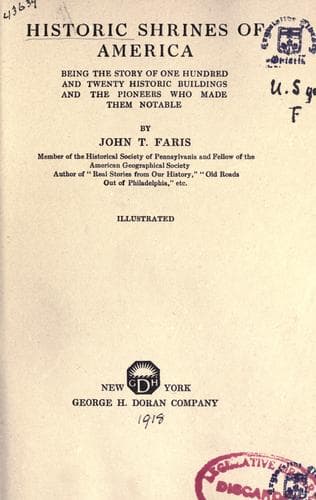
Historic Shrines of America: Being the Story of One Hundred and Twenty Historic Buildings and the Pioneers Who Made Them NotableFaris, John T. (John Thomson)
History
Historic Shrines of America: Being the Story of One Hundred and Twenty Historic Buildings and the Pioneers Who Made Them Notable
Faris, John T. (John Thomson)
Historic buildings -- United States; United States -- Biography
"Greenway contains five hundred acres, well improved. On it
is a genteel, well-furnished dwelling-house, containing six
rooms, all wainscoted, chair-board high, with fine dry
cellars the full length of the house, which is 56 feet; also
every other building which a reasonable person could wish or
desire, to wit: a handsome study, storehouse, kitchen,
laundry, dairy, meat-house, spring-house, and an ice-house
within the curtelage; a barn 40 by 34 feet, two granaries,
two carriage houses, 20 stalls for horses, a quarter for
house servants; a handsome pigeon-house, well stocked; and
several other houses for slaves; a well of water (so
excellent that I can drink with delight after returning from
a mountain circuit), a large, fertile garden, abounding with
a great variety of shrubs, herbs, and beautiful flowers, well
enclosed. The buildings new and well covered with shingles."
On this attractive estate John Tyler was born on March 29, 1790. He
was a slender, delicate-looking lad, but he was not afraid to stand up
for himself when he felt he was being abused. His first schoolmaster,
a Mr. McMurdo, who taught across the road from Greenway, thought that
it was impossible to teach well unless the rod was in daily use. "It
was a wonder that he did not whip all the sense out of his scholars,"
John said once, years later. But one day the boys rebelled. "John and
some of the larger boys tripped him up, and began to tie his hands and
feet," the Tyler family biographer tells the story. "McMurdo scuffled
bravely, but upon little William Tyler, the smallest boy in school,
throwing himself upon him, he exclaimed, in imitation of the great
Roman, '_Et tu, Brute!_' and ceased to resist. The boys firmly secured
him, locked him up in the schoolhouse, and left with cheers of triumph
and derision."
Hours later the schoolmaster was released by a passing traveller, who
heard his cries. At once the enraged man hastened to Judge Tyler and
told his story. "But the Judge, born and bred in the Revolutionary
school, hated tyranny in any shape, and as he drew himself up to his
full stature, he ... replied, in the language of Virginia's motto,
_'Sic Semper Tyrannis_.'"
At the age of twelve John entered the grammar school of William and
Mary College at Williamsburg. There he had a good time, and he made a
creditable showing in his classes. Yet that he did not advance in at
least one study is evident from a letter written by his father in
1807. He said:
"I can't help telling you how much I am mortified to find no
improvement in your handwriting; neither do you construct
your lines straight, which makes your letters look too
abominable. It is an easy thing to correct this fault, and
unless you do so, how can you be fit for law business?"
Public-domain text, read in full here on John Shaqi.
Reviews
Reviews
No reviews yet
Be the first to share your thoughts on this work.
Elsewhere in the archive
Join the Discussion
Join the discussion
Sign in to leave a comment or review.
Sign InorCreate an account