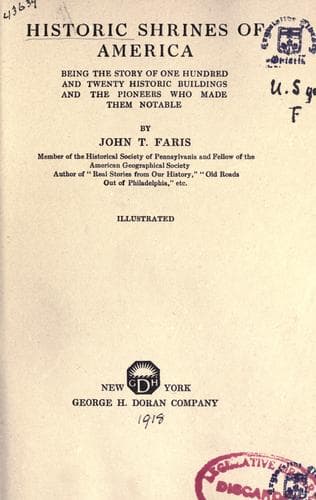
Historic Shrines of America: Being the Story of One Hundred and Twenty Historic Buildings and the Pioneers Who Made Them NotableFaris, John T. (John Thomson)
History
Historic Shrines of America: Being the Story of One Hundred and Twenty Historic Buildings and the Pioneers Who Made Them Notable
Faris, John T. (John Thomson)
Historic buildings -- United States; United States -- Biography
There is no record of the completion of the building, but probably it
was finished at the appointed time. Since that date various additions
have been made, yet it is possible to trace the lines of the original
structure. The original pews are still in use, though they have been
lowered. The hinges of the pew doors are handwrought. The wainscoting
and the window sashes are those first put in. The original
weather-boarding is still in place. It is fastened by nails whose
heads are half an inch broad.
For the new church there were imported from England:
"One Parsons Surples, a Pulpit Cushen and Cloth, two cloths
for Reading Desks, a Communion Table Cloth, and a Dozen of
Cushens--to be of good Purple Cloth, and the Surples good
Hollond, also Large Bible and four large Prayer Books."
An entry in the vestry book on December 17, 1773, shows that the
rector, Mr. Selden, received as salary 17,150 pounds of tobacco, worth
L125. The clerk of the parish received 1,789 pounds of tobacco, or L13
10s., the sexton had 536 pounds, or L3.10s.7d.
Selden was chaplain of the Virginia Convention which met in the church
March 20, 1775. At the closing session of this convention Patrick
Henry "flashed the electric spark, which exploded the country in
revolution," as Burton says in his history of Henrico Parish. This was
the speech that closed:
"Gentlemen may cry peace, peace, but there is no peace. The
war is actually begun! The next gale that sweeps from the
north will bring to our ears the clash of resounding arms!
Our brethren are already in the field! Why stand here idle?
What is it that gentlemen wish? What would they have? Is life
so dear, or peace so sweet, as to be purchased at the price
of chains and slavery? Forbid it, Almighty God. I know not
what course others may take, but as for me, Give me liberty,
or give me death."
Dr. Burton says that the orator "stood, according to tradition, near
the present corner of the east transept and the nave, or more exactly,
in pew 47, in the east aisle of the nave.... He faced the eastern wall
of the transept, where were the two windows. In the more northern of
these stood Colonel Edward Carrington. He broke the silence that
followed the orator's burning words with the exclamation, 'Right here
I wish to be buried!'"
When the British took possession of Richmond in 1781, St. John's
Church became a barracks for Arnold's men. And some of them stood on
the spot where Patrick Henry spoke the words that had such large part
in stirring up the people to drive all British soldiers from the
Colonies.
After the close of the war the diocese of Virginia was reorganized in
the building, and plans were laid to overcome the difficulties that
would soon come through the loss of the property of the Protestant
Episcopal Church, which led Edmund Randolph, later Governor of
Virginia and Secretary of State in Washington's Cabinet, to speak the
famous words:
Public-domain text, read in full here on John Shaqi.
Reviews
Reviews
No reviews yet
Be the first to share your thoughts on this work.
Elsewhere in the archive
Join the Discussion
Join the discussion
Sign in to leave a comment or review.
Sign InorCreate an account