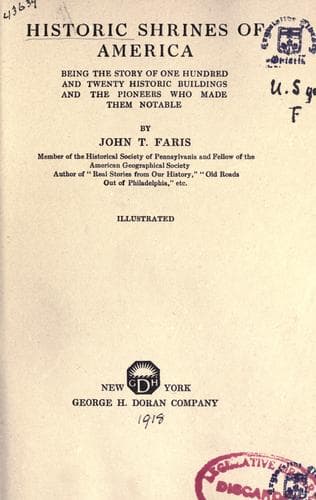
Historic Shrines of America: Being the Story of One Hundred and Twenty Historic Buildings and the Pioneers Who Made Them NotableFaris, John T. (John Thomson)
History
Historic Shrines of America: Being the Story of One Hundred and Twenty Historic Buildings and the Pioneers Who Made Them Notable
Faris, John T. (John Thomson)
Historic buildings -- United States; United States -- Biography
"Last night the playhouse in this city was crowded with an
unusual audience. There could not have been less than 600
persons in the house. Just before the conclusion of the
play, the scenery caught fire, and in a few minutes the whole
building was wrapt in flames. It is already ascertained that
61 persons were devoured by that most terrific element. The
Editor of this paper was in the house when the
ever-to-be-remembered, deplorable accident occurred. He is
informed that the scenery took fire in the back part of the
house, by raising of a chandelier; that the boy, who was
ordered by some of the players to raise it, stated, that if
he did so, the scenery would take fire, when he was commanded
in a peremptory manner, to hoist it. The boy obeyed, and the
fire was instantly communicated to the scenery."
This story the editor of the Richmond (Virginia) _American Standard_
told in the columns of his paper on Friday, December 27, 1811. He
added the fact that among those who perished were the Governor of the
State, as well as many of the leaders in the business and social life
of the city.
By order of the city council the remains of the victims were buried on
the site of the burned building, which was bought for the purpose. At
the same time it was ordered that "no person or persons should be
permitted for and during the time of four months ... to exhibit any
public show or spectacle ... within the city."
By ordinance it was also decreed that a monument should be erected on
the site. Later it was suggested that there should be built there, by
public subscription, "an edifice to be set apart and consecrated for
the worship of God," and that this should be the monument.
Accordingly, on August 1, 1812, the corner stone of the Monumental
Church was laid, the lot having been purchased by the city for $5,000.
The building was consecrated as a Protestant Episcopal church in May,
1814. In April, 1815, the subscribers to the fund for the building,
who had organized under the title, "The Association for building a
Church on Shockoe Hill," were notified that one-half of their
subscription money would be returned to them on application at the
Bank of Virginia.
In the middle of the front or main porch of the church a white marble
monument was erected to the memory of the victims of the fire.
To the General Convention of the Protestant Episcopal church, which
assembled in Philadelphia on May 18, 1814, report was made that "a
magnificent church has sprung up in Richmond from the ashes of the
Theatre; it has the patronage and support of men of the greatest
talents and highest rank in Virginia."
Among the communicants of the Monumental Church have been numbered
many of the most prominent men in the Virginia capital, and men famous
in the early history of the country were attendants from time to time.
In February, 1824, General Lafayette worshipped in the building.
LXVII
Public-domain text, read in full here on John Shaqi.
Reviews
Reviews
No reviews yet
Be the first to share your thoughts on this work.
Elsewhere in the archive
Join the Discussion
Join the discussion
Sign in to leave a comment or review.
Sign InorCreate an account