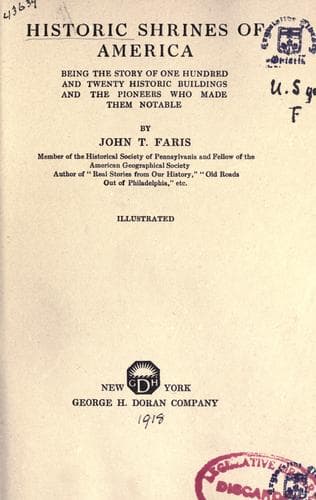
Historic Shrines of America: Being the Story of One Hundred and Twenty Historic Buildings and the Pioneers Who Made Them NotableFaris, John T. (John Thomson)
History
Historic Shrines of America: Being the Story of One Hundred and Twenty Historic Buildings and the Pioneers Who Made Them Notable
Faris, John T. (John Thomson)
Historic buildings -- United States; United States -- Biography
"His home was usually filled with friends, its dependences
with their retinue and horses. But crowds, besides, came and
went; all were received with cordiality.... Those who lived
near always came to breakfast, when all were welcomed and
made full. The larder never seemed to get lean. Breakfast
over, creature comforts, such as might console the belated
for the loss, were promptly set forth on side-tables in the
wide entrance-hall.... Meanwhile, the master saw and welcomed
all with the kindliest attention, asked of their household,
listened to their affairs, gave them his view, contented all.
These audiences seldom ceased before noon, or the early
dinner. To this a remaining party of twenty or thirty often
sat down.... The dinner ended, he betook himself to his
studies until supper, after which he again gave himself up to
enjoyment."
Not only was he a total abstainer, but as he grew older he came to
detest the odor of tobacco; so there were certain refreshments that
were never offered to the guests at Red Hill.
During the closing years of his life he spent hours over the Bible.
Every morning he would take his seat in the dining-room, with the big
family Bible open before him. Once he said to a visitor, "This book is
worth all the books that ever were printed, and it has been my
misfortune that I never found time to read it with the proper
attention and feeling till lately. I trust in the mercy of heaven that
it is not too late."
To Betsy, a daughter by his first marriage, he wrote in 1796:
"Some good people think I am no Christian. This thought gives
me much more pain than the appellation of tory; because I
think religion of infinitely higher importance than politics,
and I find much cause to reproach myself that I have lived so
long and have given no decided and public proof of my being a
Christian. But, indeed, my dear child, there is a character
which I prize far above all this world has or can boast. And
amongst all the handsome things I hear said of you, what
gives me the greatest pleasure is, to be told of your piety
and steady virtue."
As, one by one, the older children grew up and went out from Red Hill
to homes of their own, they were urged to read the Bible. Dorothea was
the first to be married. Then came Martha Catherine, who, at
seventeen, fell in love with the hero who rescued her when she fell
from a boat into the water. Sarah married Robert, the brother of the
poet Thomas Campbell. It is said that at one time the poet was engaged
to come to Red Hill as tutor for the younger children of the family,
but was unable to keep his promise.
Because of the constant pleas that were made that he give up his quiet
life and reenter politics, Henry Clay wrote, in 1796:
Public-domain text, read in full here on John Shaqi.
Reviews
Reviews
No reviews yet
Be the first to share your thoughts on this work.
Elsewhere in the archive
Join the Discussion
Join the discussion
Sign in to leave a comment or review.
Sign InorCreate an account