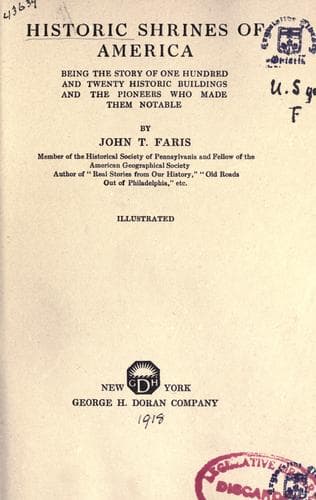
Historic Shrines of America: Being the Story of One Hundred and Twenty Historic Buildings and the Pioneers Who Made Them NotableFaris, John T. (John Thomson)
History
Historic Shrines of America: Being the Story of One Hundred and Twenty Historic Buildings and the Pioneers Who Made Them Notable
Faris, John T. (John Thomson)
Historic buildings -- United States; United States -- Biography
"You can never exchange the present government, but for a
monarchy. If the administration have done wrong, let us all
go wrong together, rather than split into factions, which
must destroy that union upon which our existence hangs. Let
us preserve our strength for the French, the English, the
German, or whoever else shall dare to invade our territory,
and not exhaust it in civil commotion and intestine wars."
After the conclusion of the oration, Henry went back to Red Hill, and
never left it again. In April he was triumphantly elected, but he was
unable to take his seat.
On June 6, 1799, he was near death. When the physician offered him a
vial of mercury, at the same time telling him that the remedy might
prolong his life a little while, or it might be fatal, he drew over
his eyes a silken cap which he usually wore, and, holding the vial in
his hands, made "a simple childlike prayer for his family, for his
country, and for his own soul. Afterwards in perfect calm he swallowed
the medicine."
His last word was to his physician, commending the Christian religion,
which was so real a benefit to a man about to die.
Patrick Henry and his wife lie side by side in the rear garden of Red
Hill. "His fame his best epitaph" is the simple inscription on the
stone above the patriot.
[Illustration: POHICK CHURCH, VIRGINIA
_Photo furnished by Aymar Embury, II_
See page 311]
LXX
POHICK CHURCH, TRURO PARISH, VIRGINIA
THE HOME CHURCH OF GEORGE WASHINGTON
Both Truro parish and George Washington were born in 1732, and
Washington's connection with Truro Church began in 1735, when his
father, Augustine Washington, became a vestryman, and it continued
throughout his life, though during his later years, when services were
seldom held there, he went to Christ Church at Alexandria.
When Washington was a boy he had to make a round trip of eighteen
miles, frequently over extremely rough roads, when he wished to attend
services. Yet he was a faithful attendant, at all seasons.
A number of the early rectors of Truro were welcome guests at Mt.
Vernon. One of these, Charles Green, was a physician as well as a
minister, as appears from the record that he was called to prescribe
for Washington in 1757, when the young campaigner was so seriously
ill, in consequence of hardships suffered on his western trip, that he
said he had "too much reason to apprehend an approaching decay."
Public-domain text, read in full here on John Shaqi.
Reviews
Reviews
No reviews yet
Be the first to share your thoughts on this work.
Elsewhere in the archive
Join the Discussion
Join the discussion
Sign in to leave a comment or review.
Sign InorCreate an account