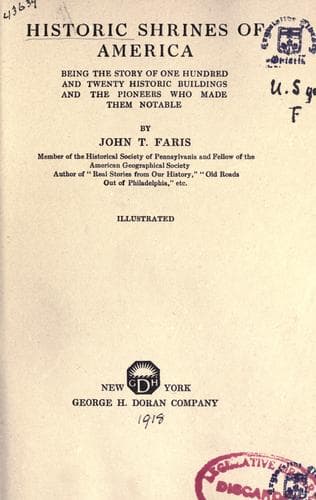
Historic Shrines of America: Being the Story of One Hundred and Twenty Historic Buildings and the Pioneers Who Made Them NotableFaris, John T. (John Thomson)
History
Historic Shrines of America: Being the Story of One Hundred and Twenty Historic Buildings and the Pioneers Who Made Them Notable
Faris, John T. (John Thomson)
Historic buildings -- United States; United States -- Biography
Washington's friendship led him to make his winter home in the
District of Columbia. In 1801 he occupied the Octagon House, then the
finest private residence in the city. When the British burned the
White House he was at Mount Airy. At once he sent a mounted messenger
to President Madison, offering the use of the Octagon as the temporary
Executive Mansion.
His establishment at Mount Airy was maintained in remarkable splendor.
His household and equipages were the talk of the neighborhood. A lover
of fine horseflesh, he was the owner of some of the swiftest animals
of his day.
The eldest son, John Tayloe, inherited his father's ardor for public
service. He was engaged brilliantly in the battles of the
_Constitution_ with the _Guerriere_, and with the _Cyano_ and the
_Levant_. After the action his native State gave him a sword, and he
was promoted to a lieutenancy. Though he was captured by the British,
he lived to return to Mount Airy, where he died in 1824. His father
died four years later, while his mother lived until 1855.
Mount Airy has always been in the hands of a Tayloe. It is now in
possession of the family of the late Henry Tayloe.
LXXII
TWO OF VIRGINIA'S OLDEST CHURCH BUILDINGS
ST. LUKE'S, IN SMITHFIELD, AND ST. PETER'S, IN NEW KENT COUNTY
Captain Smith in 1607 wrote of his discovery of the Indian kingdom of
Warrosquoyacke. Soon settlers were attracted to its fertile lands.
Twenty-seven years later the more than five hundred residents were
organized into Isle of Wight County.
In 1632, the ancient brick church near Smithfield was built. The
tradition fixing this date was established in 1887, when the date 1632
was read in some bricks that fell from the walls.
The builder of the staunch church was Joseph Bridger, who was
Counsellor of State to Charles II. He is buried not far from the
church, and on his tomb is the inscription: "He dyed April 15 Anno
Domini 1688 Aged 58 years. Mournfully leaving his wife, three sons and
four daughters."
The oldest vestry book dates from 1727, for the first book was
destroyed at the time of General Arnold's expedition made to Isle of
Wight County, in the effort to capture General Parker, of the
Continental Army. Fortunately, however, a few other records were
saved. An entry in 1727 spoke of "The Old Brick Church"; evidently the
name St. Luke's was of later origin.
The architectural beauty of the old building is described in a
pleasing manner by Aymar Embury, II, the well-known New York
architect, in his "Early American Churches":
Public-domain text, read in full here on John Shaqi.
Reviews
Reviews
No reviews yet
Be the first to share your thoughts on this work.
Elsewhere in the archive
Join the Discussion
Join the discussion
Sign in to leave a comment or review.
Sign InorCreate an account