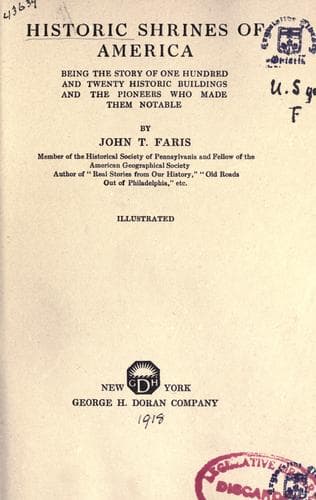
Historic Shrines of America: Being the Story of One Hundred and Twenty Historic Buildings and the Pioneers Who Made Them NotableFaris, John T. (John Thomson)
History
Historic Shrines of America: Being the Story of One Hundred and Twenty Historic Buildings and the Pioneers Who Made Them Notable
Faris, John T. (John Thomson)
Historic buildings -- United States; United States -- Biography
"Monticello is quite a high mountain, in the shape of a
sugar-loaf. A winding road led up to the mansion. On the very
top of the mountain the forest trees were cut down, and ten
acres were cleared and levelled.... I know every room in that
house. Under the house and the terrace that surrounded it,
were the cisterns, ice-house, cellar, kitchen, and rooms for
all sorts of purposes. His servants' rooms were on one
side.... There were no negro and other out-houses around the
mansion, as you generally see on plantations. The grounds
around the house were beautifully ornamented with flowers and
shrubbery.... Back of the house was a beautiful lawn of two
or three acres, where his grandchildren used to play.
"His garden was on the side of the mountain. I had it built
while he was President. It took a great deal of labor. We had
to blow out the rocks for the walls for the different
terraces, and then make the soil.... I used to send a servant
to Washington with a great many fine things for his table,
and he would send back the cart loaded with shrubbery."
Jefferson spent most of his time on his estate until his death in
1826, except when he was called away for the service of his country.
Nine years after the beginning of the happy married life in Monticello
there was a panic among the servants because of the approach of the
British. Because Jefferson was Governor of Virginia, it was thought
that of course the mansion would be pillaged. Mrs. Jefferson was put
in the carriage and sent to a place of safety, while Mr. Jefferson
remained at home, collecting his most valuable papers. Later he
followed his family. But when the soldiers reached the estate, the
first inquiry of the leader of the party was for the master of the
house. When he learned that Jefferson had escaped, he asked for the
owner's private rooms, and, on being shown the door which led to them,
he turned the key in the lock and ordered that nothing in the house
should be touched. This, it was explained, was in strict accordance
with the orders that had been given by General Tarleton; their sole
duty was to seize the Governor.
A year later, when the Marquis de Chastellux, a nobleman from France,
visited Monticello, he was charmed with the house of which Mr.
Jefferson was the architect, and often one of the workmen. He said it
was "rather elegant, and in the Italian taste, though not without
fault; it consists of one large square pavilion, the entrance of which
is by two porticoes, ornamented with pillars. The ground floor
consists of a very large lofty saloon, which is to be decorated
entirely in the antique style; above it is a library of the same
size; two small wings, with only a ground floor and attic story, are
joined to this pavilion, and communicate with the kitchen, offices,
etc., which will form a kind of basement story, over which runs a
terrace."
Public-domain text, read in full here on John Shaqi.
Reviews
Reviews
No reviews yet
Be the first to share your thoughts on this work.
Elsewhere in the archive
Join the Discussion
Join the discussion
Sign in to leave a comment or review.
Sign InorCreate an account