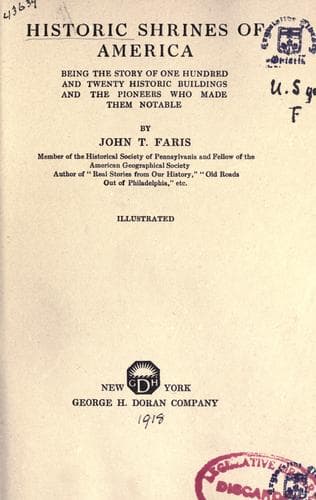
Historic Shrines of America: Being the Story of One Hundred and Twenty Historic Buildings and the Pioneers Who Made Them NotableFaris, John T. (John Thomson)
History
Historic Shrines of America: Being the Story of One Hundred and Twenty Historic Buildings and the Pioneers Who Made Them Notable
Faris, John T. (John Thomson)
Historic buildings -- United States; United States -- Biography
William Whitley, I am your horne,
The truth I love, a lie I scorne,
Fill me with the best of powder,
I'll make your rifle crack the louder.
See how the dread, terrifick ball
Makes Indians blench at Toreys fall,
You with powder I'll supply
For to defend your liberty.
One day in 1785 a messenger came to Whitley's Fort with the tidings
that Indians had captured a mother and her babe, after killing three
older children. Mr. Whitley was not at home, but Mrs. Whitley sent for
him. In the meantime she collected a company of twenty rescuers. On
his return Whitley placed himself at their head, pursued the Indians,
and rescued the prisoners.
The title Colonel was given to Whitley in 1794, when he commanded the
Nickerjack expedition against the Tennessee Indians, who had been
conducting foraging expeditions into Kentucky. The march was conducted
with such secrecy and despatch that the enemy were taken by surprise,
and were completely routed.
The last of his campaigns took place in Canada against the British,
French, and Indians in 1813. Many claim that before he received his
mortal wound in the battle of the Thames, he fired the shot that
killed Tecumseh, the chief who had given so much trouble to the
settlers of Kentucky and Indiana. Others say that the shot was fired
by a Colonel Johnson.
The body of the Indian fighter rests in an unknown grave hundreds of
miles from the territory he helped to wrest from the Indians, but the
brick house he built near Crab Orchard is still one of the historic
buildings of Kentucky.
[Illustration: WHITE HAVEN, ST. LOUIS
_Photo furnished by Albert Wenzlick_
See page 362]
LXXXIII
WHITE HAVEN, NEAR ST. LOUIS, MISSOURI
WHERE ULYSSES S. GRANT COURTED JULIA DENT
Immediately after Ulysses Simpson Grant graduated from West Point, he
was sent to Jefferson Barracks, at St. Louis. His military duties were
not so arduous that he was unable to accept the invitation of Fred
Dent, a former roommate at West Point, to go with him to the Dent
homestead on the Gravois Road, four miles from the Barracks.
The young second lieutenant did not have to be urged to repeat his
visit. In fact he went so often that the road between the Barracks and
the Dent farm became as familiar to him as his old haunts on the banks
of the Hudson. He did not meet Julia Dent at first, for she was absent
at school, but he found enough attraction in a sister to make him a
frequent visitor.
Then came the eventful day when he met seventeen-year-old Julia. The
courtship was by no means a long-drawn-out affair; the young people
were engaged before Grant was ordered to the Mexican border, though
the fact was not announced until his return to St. Louis in May, 1845.
The marriage took place in August, 1848, after the close of the
Mexican War.
Public-domain text, read in full here on John Shaqi.
Reviews
Reviews
No reviews yet
Be the first to share your thoughts on this work.
Elsewhere in the archive
Join the Discussion
Join the discussion
Sign in to leave a comment or review.
Sign InorCreate an account