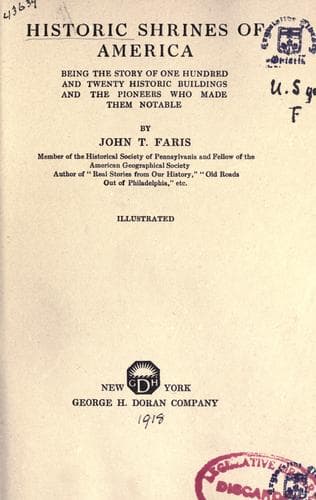
Historic Shrines of America: Being the Story of One Hundred and Twenty Historic Buildings and the Pioneers Who Made Them NotableFaris, John T. (John Thomson)
History
Historic Shrines of America: Being the Story of One Hundred and Twenty Historic Buildings and the Pioneers Who Made Them Notable
Faris, John T. (John Thomson)
Historic buildings -- United States; United States -- Biography
"It was a pleasant mansion, an abode
Near and yet hidden from the great high-road,
Sequestered among trees, a noble pile,
Baronial and colonial in its style;
Gables and dormer-windows everywhere,
And stacks of chimneys rising high in air--
Pandaean pipes, on which all winds that blew
Made mournful music the whole winter through.
Within, unwonted splendors met the eye,
Panels, and floors of oak, and tapestry;
Carved chimney-pieces, where on brazen dogs
Revelled and roared the Christmas fire of logs;
Doors opening into darkness unawares,
Mysterious passages, and flights of stairs,
And on the walls, in heavy gilded frames,
The ancestral Wentworths with Old-Scripture names."
While Governor Wentworth was an important figure during the days
preceding the Revolution, the mansion is celebrated not so much
because of his political service as because of the romance of his
second marriage.
Martha Hilton, the heroine of the romance, was "a careless, laughing,
bare-footed girl." One day a neighbor saw her, in a short dress,
carrying a pail of water in the street. "You, Pat! You, Pat! Why do
you go looking so? You should be ashamed to be seen in the street!"
was the shocked comment. But the answer was not what the neighbor
expected. "No matter how I look, I shall ride in my chariot yet,
Marm."
The story of what followed is told by Charles W. Brewster, a historian
of old Portsmouth:
"Martha Hilton afterwards left home, and went to live in the
Governor's mansion at Little Harbor, doing the work of the
kitchen, and keeping the house in order, much to the
Governor's satisfaction.... The Governor has invited a dinner
party, and with many other guests, in his cocked hat comes
the beloved Rev. Arthur Brown, of the Episcopal church. The
dinner is served up in a style becoming the Governor's
table.... There is a whisper from the Governor to a
messenger, and at his summons Martha Hilton comes in from
that door on the west of the parlor, and, with blushing
countenance, stands in front of the fireplace. She seems
heedless of the fire--she does not appear to have brought
anything in, nor does she seem to be looking for anything to
carry out--there she stands! a damsel of twenty summers--for
what, no visitor can tell.
"The Governor, bleached by the frosts of sixty winters,
rises. 'Mr. Brown, I wish you to marry me.' 'To whom?' asks
his pastor, in wondering surprise. 'To this lady,' was the
reply. The rector stood confounded. The Governor became
imperative. 'As the Governor of New Hampshire I command you
to marry me!' The ceremony was then duly performed, and from
that time Martha Hilton became Lady Wentworth."
Longfellow's record of the incident is given in the poem, "Lady
Wentworth":
Public-domain text, read in full here on John Shaqi.
Reviews
Reviews
No reviews yet
Be the first to share your thoughts on this work.
Elsewhere in the archive
Join the Discussion
Join the discussion
Sign in to leave a comment or review.
Sign InorCreate an account