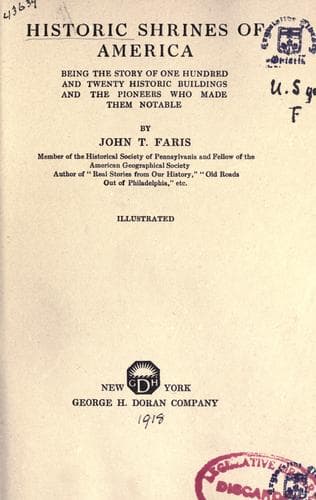
Historic Shrines of America: Being the Story of One Hundred and Twenty Historic Buildings and the Pioneers Who Made Them NotableFaris, John T. (John Thomson)
History
Historic Shrines of America: Being the Story of One Hundred and Twenty Historic Buildings and the Pioneers Who Made Them Notable
Faris, John T. (John Thomson)
Historic buildings -- United States; United States -- Biography
The members of the new church were called "a misguided band," and "new
schemers." Their first pastor was called a dissenting minister. Their
protest against these aspersions took the form of a petition to "The
King's Most Excellent Majesty," which was a prayer for that "equal
liberty of conscience in worshipping God" that had already been
granted to others. The petition recited the desire of the people to be
relieved of taxation "for the support of ministers on whose ministry
they cannot in conscience attend," and stated that, because of their
refusal to pay what they felt were unjust taxes, "honest and peaceable
men have been hauled away to prison to their great hurt and damage."
When the petition was presented to the king by Mr. Partridge, their
agent, he declared that they were not "a wild, friekish people," and
cited as an argument for relief from double taxation that, while they
had some wealthy members, there were among them "more poor widows than
all the other congregations in town put together." He said those who
protested against double taxation had been "dragged about upon the
ground," dressed up in bear skins and worried, and imprisoned.
The protest did not bring relief at once; it was 1773 before the
General Court granted the plea of the members. For more than twenty
years more the town tried to collect double taxes, but in 1795 the
rights of the members of Old South were conceded.
The first building, erected in 1743, gave way in 1756 to the structure
still in use. Alterations made since that time have not made any great
change in its appearance, except in the tower, which was repaired in
1848, because it was thought that the timber must be decaying.
However, to the surprise of the carpenters who undertook the repairs,
they were found as sound as ever. A half-hour was required to saw
through one of them!
The bell in the new tower was cast by Paul Revere. Surmounting the
spire is a cock which was perched on the original tower. When this
tower, after the carpenters had done all they could with their saws,
was pulled over by horses and oxen, the cock broke loose and fell at
some distance. The man who picked up the figure was surprised to find
that it was of solid copper, instead of wood, as had been thought, and
that it weighed more than fifty pounds.
In the original pews there was a central chair, surrounded by seats
hung on hinges. Over the pulpit was a sounding board. At the head of
the pulpit stair a seat was provided for the sexton, that he might be
on hand to trim the candles during the evening service.
The official history of the church, written by Dr. H. C. Hovey, gives
interesting facts concerning the heating of the old building:
Public-domain text, read in full here on John Shaqi.
Reviews
Reviews
No reviews yet
Be the first to share your thoughts on this work.
Join the Discussion
Join the discussion
Sign in to leave a comment or review.
Sign InorCreate an account