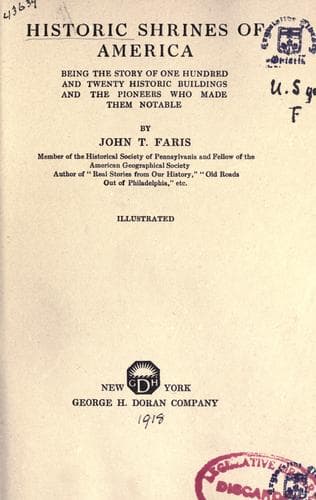
Historic Shrines of America: Being the Story of One Hundred and Twenty Historic Buildings and the Pioneers Who Made Them NotableFaris, John T. (John Thomson)
History
Historic Shrines of America: Being the Story of One Hundred and Twenty Historic Buildings and the Pioneers Who Made Them Notable
Faris, John T. (John Thomson)
Historic buildings -- United States; United States -- Biography
"For seventy years those who crowded this church depended on
footstoves altogether for warmth in winter; while the
minister preached in his ample cloak, and wore gloves with a
finger and thumb cut off to enable him the better to turn the
leaves. A law was made allowing the sexton twenty cents for
each footstove that he had to fill before service and remove
afterward. A great sensation was made in 1819 by the
introduction of wood stoves at an outlay of $100. The first
day they were in place the people were so overcome that some
of them fainted away and were carried out of the house; but
they revived on learning that as yet no fire had been
kindled in the new stoves. The doors of the stoves opened
into the ample vestibule, where the custom continued of
ranging the many footstoves in a wide circle to be filled
with live coals from the stove."
On the Sunday after the battle of Lexington Dr. Jonathan Parsons made
an appeal in the name of liberty. After this Captain Ezra Lunt stepped
into the aisle and formed a company of sixty men, which is said to
have been the first company of volunteers to join the Continental
Army.
Later Newburyport supplied a number of companies. But the call came
for still another company. "Day after day the recruiting officers
toiled in vain," Dr. Hovey writes, "Finally the regiment was invited
to the Presbyterian church, where they were addressed in such spirited
and stirring words that once again a number of this church stepped
forth to take the covenant, and in two hours after the benediction had
been spoken the entire company was raised."
During the war twenty-two vessels and one thousand men, from the towns
of Newbury and Newburyport, were lost at sea. The first American flag
seen in British waters, after the cessation of hostilities, was
displayed in the Thames by Nicholas Johnson of Newburyport, captain of
the _Compte de Grasse_.
Among the treasures of the church is the Bible which Whitefield used.
The evangelist, who died Sunday, September 30, 1770, is buried in the
crypt under the pulpit where he had planned to preach on the very day
of his death, as he had preached many times during the years since the
building of the church. To this dark crypt thousands of reverent
visitors have groped their way. One, less reverent, removed an arm of
the skeleton and carried it to England as a relic. No one knew what
had become of it until, after the death of the thief, it was returned
to Newburyport, together with a bust of Whitefield. This bust is also
one of the treasures of Old South.
Those who love this old church at Newburyport delight in the lines of
John Greenleaf Whittier:
Public-domain text, read in full here on John Shaqi.
Reviews
Reviews
No reviews yet
Be the first to share your thoughts on this work.
Join the Discussion
Join the discussion
Sign in to leave a comment or review.
Sign InorCreate an account