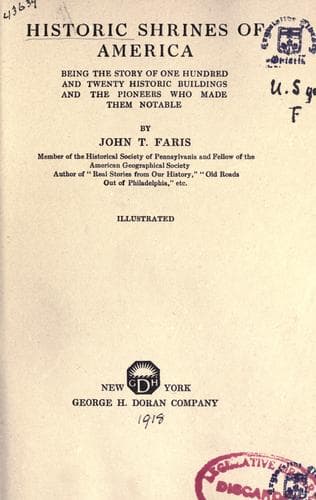
Historic Shrines of America: Being the Story of One Hundred and Twenty Historic Buildings and the Pioneers Who Made Them NotableFaris, John T. (John Thomson)
History
Historic Shrines of America: Being the Story of One Hundred and Twenty Historic Buildings and the Pioneers Who Made Them Notable
Faris, John T. (John Thomson)
Historic buildings -- United States; United States -- Biography
In the same address Dr. Dix said: "The church remains, substantially,
such as it was in the first days; alterations have been made in it,
but they have not changed its general appearance. For justness of
proportion and elegance of style, it still holds a leading place among
our city churches, and must be regarded as a fine specimen of its
particular school of architecture. When it was built, the western end
commanded an uninterrupted view of the river and the Jersey shore, for
the waters of the Hudson then flowed up to the line of Greenwich
Street, all beyond is made land."
In the portico of the old church is a monument to General Montgomery,
a member of St. Paul's parish, who fell at Quebec, and is buried in
the chapel. This monument, which was sent from France by Benjamin
Franklin, had an adventurous career. The vessel in which it was
shipped was captured by the British, and some time elapsed before it
reached its destined place.
[Illustration: FRAUNCES' TAVERN, NEW YORK CITY
_Photo by Frank Cousins Art Company_
See page 97]
XX
FRAUNCES' TAVERN, NEW YORK CITY
WHERE WASHINGTON TOOK LEAVE OF HIS SOLDIERS
The subscribers of the _Pennsylvania Packet_, on the morning of
December 2, 1783, read the following pleasing despatch from New York
City, which was dated November 26, 1783:
"Yesterday in the morning the American troops marched from
Haerlem, to the Bowery lanes. They remained there until about
one o'clock, when the British troops left the fort in the
Bowery, and the American troops marched in and took
possession of the city.--After the troops had taken
possession of the city, the GENERAL and GOVERNOR made their
public entry in the following manner:--Their excellencies the
general and governor with their suites on horseback. The
lieutenant governor, and the members of the council for the
temporary government of the southern district, four
a-breast.--Major-general Knox, and the officers of the army,
eight a-breast.--Citizens on horseback, eight a-breast.--The
speaker of the assembly and citizens, on foot, eight
a-breast.
"Their excellencies the governor and commander-in-chief were
escorted by a body of West Chester light horse, under the
command of Captain Delavan. The procession proceeded down
Queen [now Pearl] Street, and through the Broad-way to Cape's
Tavern. The governor gave a public dinner at Fraunces'
tavern; and which the commander-in-chief, and other general
officers were present."
The building which Washington made famous that day was erected by
Etienne de Lancey, probably in 1700. Samuel Fraunces purchased the
place in 1762. Soon it became one of the most popular taverns in New
York. Among its patrons were some of the leaders in the Revolution, as
well as many who were loyal to King George. But Fraunces himself never
wavered in his allegiance to the Colonies.
Public-domain text, read in full here on John Shaqi.
Reviews
Reviews
No reviews yet
Be the first to share your thoughts on this work.
Elsewhere in the archive
Join the Discussion
Join the discussion
Sign in to leave a comment or review.
Sign InorCreate an account