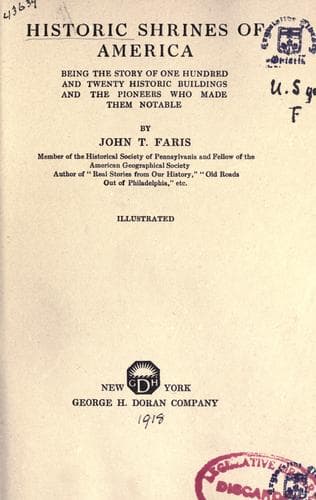
Historic Shrines of America: Being the Story of One Hundred and Twenty Historic Buildings and the Pioneers Who Made Them NotableFaris, John T. (John Thomson)
History
Historic Shrines of America: Being the Story of One Hundred and Twenty Historic Buildings and the Pioneers Who Made Them Notable
Faris, John T. (John Thomson)
Historic buildings -- United States; United States -- Biography
On the opening day there was no steeple, no organ, and no stove. But
those who entered the doors were abundantly satisfied with the work of
the architect, who is said to have been a Scotchman named McBean, a
pupil of Gibbs, the designer of St. Martins-in-the-Fields, London, to
which church the interior of St. Paul's Chapel bears a marked
resemblance. In the account of the opening the New York _Journal and
General Advertiser_ said that the new church was "one of the most
elegant edifices on the Continent."
Between April 13, 1776, when Washington arrived in New York, and
September 15, 1776, when Lord Howe occupied the city, the church was
closed, since the rector did not see his way to omit from the service
the prayers for the king. But when the British took possession of New
York the doors were opened once more. Until the city was evacuated,
November 25, 1783, Lord Howe and many of his officers were regular
attendants at St. Paul's.
Six days after the beginning of the British occupation the church had
a narrow escape from destruction. A fire, which Howe declared was of
incendiary origin, burned four hundred of the four thousand homes in
New York. St. Paul's Chapel was in the centre of the burnt district.
Trinity Church was destroyed, and St. Paul's was saved by the efforts
of its rector, Dr. Inglis. This was the first of five such narrow
escapes. The steeple was actually aflame during the conflagration of
1797, but the building was saved. Three times during the nineteenth
century, in 1820, 1848, and 1865, fire approached or passed by the
chapel.
Immediately after the first inauguration of Washington, at the City
Hall, he walked to St. Paul's to ask God's blessing on the country and
his administration. During his residence in New York, until Trinity
Church was rebuilt, he was a regular attendant at the services. From
1789 to 1791 his diary records the fact many times, "Went to St.
Paul's Chappel in the forenoon." At first he used the pew built for
the Governor of New York, but later, when a President's pew was built,
he moved to this. Canopies covered both pews, while they were further
marked by the arms of the United States and of New York.
Dr. Morgan Dix, in his address at the Centennial anniversary of the
completion of the building, told of an old man who had said to him
that when he was a boy he used to sit with other school-boys in the
north gallery, and from there he would watch the arrival of the
General and "Lady Washington" as they came up Fair Street to the
church, in a coach and four.
Public-domain text, read in full here on John Shaqi.
Reviews
Reviews
No reviews yet
Be the first to share your thoughts on this work.
Elsewhere in the archive
Join the Discussion
Join the discussion
Sign in to leave a comment or review.
Sign InorCreate an account