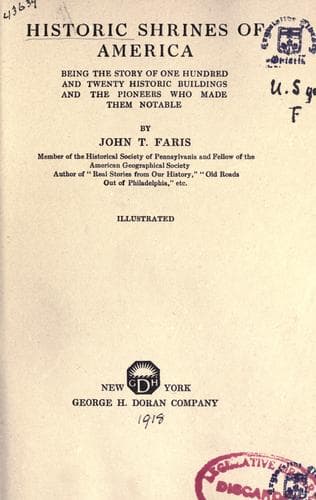
Historic Shrines of America: Being the Story of One Hundred and Twenty Historic Buildings and the Pioneers Who Made Them NotableFaris, John T. (John Thomson)
History
Historic Shrines of America: Being the Story of One Hundred and Twenty Historic Buildings and the Pioneers Who Made Them Notable
Faris, John T. (John Thomson)
Historic buildings -- United States; United States -- Biography
There was a time when Benjamin Franklin was proud of his son William,
and was glad to have his name coupled with that of the young man.
The first year of the father's service in the Pennsylvania Assembly
William was appointed clerk of that body; this fact is mentioned with
pride in the Autobiography.
When General Braddock was sent from England to America to oppose the
union of the Colonies for defence, "lest they should thereby grow too
military and feel their own strength," Franklin was sent by the
Assembly to Fredericktown, Maryland, to confer with the General. "My
son accompanied me on the journey," the Autobiography says.
At Braddock's request Franklin advertised at Lancaster, Pennsylvania,
for one hundred and fifty wagons for the proposed expedition into the
interior, and at the close of the advertisement was the note, "My son,
William Franklin, is empowered to enter into like contracts with any
person in Cumberland County."
Later, when the father was asked to secure financial assistance for
certain subalterns in Braddock's company, he wrote to the Assembly,
recommending that a present of necessaries and refreshments be sent to
those officers. "My son, who had some experience of camp life and of
its wants, drew up a list for me which I enclos'd in my letter," the
father wrote.
When, during the French and Indian War, the Governor of Pennsylvania
asked Franklin to take charge of "our Northwestern frontier which was
infested by the enemy, and provide for the defence of the inhabitants
by raising troops and building a line of forts," he went to the front
with five hundred and sixty men. In the Autobiography he wrote, "My
son, who had in the preceding war, been an officer in the army rais'd
against Canada, was my aid-de-camp, and of great use to me."
And in 1771, when beginning his Autobiography, Franklin addressed it
"Dear Son," and spoke of the trip the two had taken together to
England, to make "enquiries among the remains of my relations." Then
he added:
"Imagining it may be equally agreeable to you to know the
circumstances of my life, many of which you are yet
unacquainted with, and expecting the enjoyment of a week's
uninterrupted leisure in my present country retirement, I sit
down to write them for you."
Six years before the beginning of the Autobiography, Franklin, in
company with six other Philadelphians, entered on a land speculation
in Nova Scotia. Together they bought two hundred thousand acres of
land. There they intended to found a colony. Two shiploads of
emigrants were taken to Monkton, the site of the proposed colony, but
most of the men settled on other land, finding that this could be had
practically for nothing. Franklin's will later provided that William
be given an interest in the Nova Scotia property, and he explained the
gift by saying that this was "the only part of his estate remaining
under the sovereignty of the king of Great Britain."
Public-domain text, read in full here on John Shaqi.
Reviews
Reviews
No reviews yet
Be the first to share your thoughts on this work.
Elsewhere in the archive
Join the Discussion
Join the discussion
Sign in to leave a comment or review.
Sign InorCreate an account