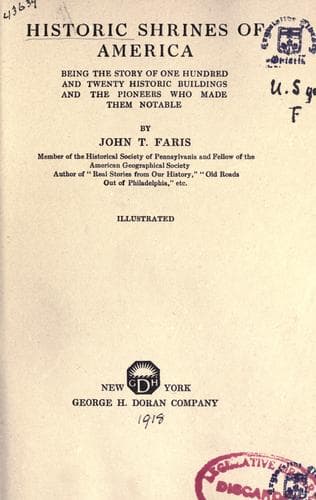
Historic Shrines of America: Being the Story of One Hundred and Twenty Historic Buildings and the Pioneers Who Made Them NotableFaris, John T. (John Thomson)
History
Historic Shrines of America: Being the Story of One Hundred and Twenty Historic Buildings and the Pioneers Who Made Them Notable
Faris, John T. (John Thomson)
Historic buildings -- United States; United States -- Biography
The trying days of the Revolution would not seem to be a favorable
time for the beginning of a church, especially in the section of New
Jersey which was so often overrun by the soldiers of both armies. Yet
it was at this critical time that many of the people of Horseneck (now
Caldwell), New Jersey, near Montclair, were looking forward to the
organization of a church and the building of a house of worship.
Timbers were in fact drawn and framed for church purposes, but the war
interfered with the completion of the project.
The donation, in 1779, of ninety acres of wild land in the centre of
the settlement gave the prospective congregation new heart. On this
land a parsonage was begun in 1782. The upper portion of this house,
unplastered and unceiled, was used for church purposes until 1796.
The final organization of the church dates from December 3, 1784, when
forty persons signed their names to the following curious agreement:
"We Whose Names are Under writen Living at the Place called
Horse Neck, Being this Day to be Formed or Embodied as a
Church of _Jesus Christ_, Do Solemnly Declare that as we do
desire to be founded Only on the Rock Christ Jesus, So we
would not wish to Build on this foundation, Wood Hay and
Stubble, but Gold and Silver and Precious Stones; and as it
is our profested Sentiments that a Visible Church of Christ,
Consists of Visible Believers with their Children, so no
Adult Persons ought to be Admitted as members but such as
Credibly profess True Faith in Jesus Christ, Love, Obedience,
and Subjection to Him, Holding the Fundamental Doctrines of
the Gospel, and who will Solemnly Enter into Covenant to Walk
Worthy such an Holy Profession as we do this Day."
The last survivor of those who signed this document was General
William Gould, who died February 12, 1847, in his ninetieth year.
During the Revolution he saw much active service, especially at the
battles of Springfield and Monmouth and the campaigns that preceded
and followed these conflicts.
But the connection of the church with the Revolution came rather
through Rev. James Caldwell, who was pastor of the First Presbyterian
Church of Elizabeth Town. During the early years of the struggling
congregation he was their adviser and helper, and after his death the
name of the church was changed to Caldwell, in his honor.
Mr. Caldwell--who had among his parishioners in Elizabeth Town William
Livingston, the Governor of the State, Elias Boudinot, Commissary
General of Prisons and President of Congress, Abraham Clark, one of
the signers of the Declaration of Independence, as well as more than
forty commissioned officers of the Continental Army--was one of the
famous chaplains of the war, having been chosen in 1776 chaplain of
the regiment largely made up of his own members. Later he was
Assistant Commissary General.
Public-domain text, read in full here on John Shaqi.
Reviews
Reviews
No reviews yet
Be the first to share your thoughts on this work.
Elsewhere in the archive
Join the Discussion
Join the discussion
Sign in to leave a comment or review.
Sign InorCreate an account