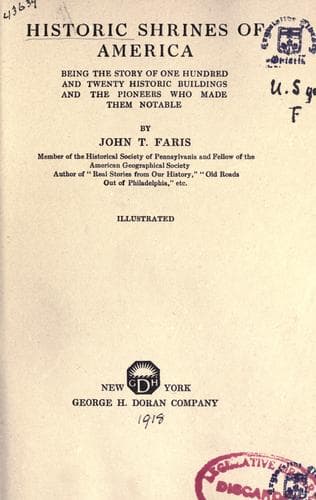
Historic Shrines of America: Being the Story of One Hundred and Twenty Historic Buildings and the Pioneers Who Made Them NotableFaris, John T. (John Thomson)
History
Historic Shrines of America: Being the Story of One Hundred and Twenty Historic Buildings and the Pioneers Who Made Them Notable
Faris, John T. (John Thomson)
Historic buildings -- United States; United States -- Biography
THREE HEADQUARTERS OF WASHINGTON
PENNYPACKER'S MILLS, DAWESFIELD, AND EMLEN HOUSE, NEAR PHILADELPHIA
During the closing months of 1777, one of the darkest times of the
Revolution, Washington made famous by his occupancy three houses, all
located within a few miles of Philadelphia. The first of these,
Pennypacker's Mills, is the only building used by the Commander-in-Chief
during the war that is still in the hands of the family that owned it
when he was there.
Pennypacker's Mills is delightfully situated in the angle formed by
the union of the two forks of the Perkiomen, the largest tributary of
the Schuylkill. Hans Joest Heijt, who built the grist mill and house
on the land in 1720, sold the property in 1730 to John Pauling. He was
succeeded in 1757 by Peter Pannebecker. His son Samuel was the
owner of the house by the creek when, on September 26, 1777,
Washington reached the Mills.
The orderly book of the following days and letters written from the
house shed light on the events of the stay here.
On the day he reached the Mills, Washington wrote to William Henry at
Lancaster:
"You are hereby authorized to impress all the Blankets,
Shoes, Stockings, and other Articles of Clothing that can be
spared by the Inhabitants of the County of Lancaster, for the
Use of the Continental Army, paying for the same at
reasonable Rates or giving Certificates."
The entry in the orderly book on September 28 read:
"The Commander-in-Chief has the happiness again to
congratulate the army on the success of the Americans to the
Northward. On the 19th inst. an engagement took place between
General Burgoyne's army and the left wing of ours, under
General Gates. The battle began at 10 o'clock, and lasted
till night--our troops fighting with the greatest bravery,
not giving an inch of ground.... To celebrate this success
the General orders that at 4 o'clock this afternoon all the
troops be paraded and served with a gill of rum per man, and
that at the same time there be discharges of 13 pieces of
artillery from the park."
On the same day there was a council of war. It was found that there
were in camp, fit for duty, 5,472 men. The whole army in all the camps
then contained about eight thousand Continental troops and three
thousand militia.
Next day Washington wrote:
"I shall move the Army four or five miles lower down to-day
from whence we may reconnoitre and fix upon a proper
situation, at such distance from the Enemy, as will entitle
us to make an attack, should we see a proper opening, or
stand upon the defensive till we obtain further
reinforcements...."
Later in the day the army marched to Skippack, within about
twenty-five miles of Philadelphia. The next stage in the advance was
Methacton Hill, and from there the army began to move, on October 3,
at seven o'clock in the evening, to the attack on the British at
Germantown.
Public-domain text, read in full here on John Shaqi.
Reviews
Reviews
No reviews yet
Be the first to share your thoughts on this work.
Elsewhere in the archive
Join the Discussion
Join the discussion
Sign in to leave a comment or review.
Sign InorCreate an account