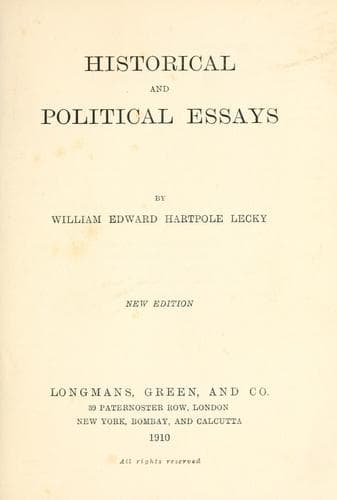
Historical and Political EssaysLecky, William Edward Hartpole
History
Historical and Political Essays
Lecky, William Edward Hartpole
History; Political science
A book of larger scope and of more serious influence soon followed.
Germany at this time presented the singular spectacle of a people who
had been reduced to the lowest depths of political depression, but
who, at the same time, could boast of a contemporary literature that
was the first in the world. In France a translation of 'Werther' had
attained great popularity; some of the plays of Schiller, the idylls
of Gessner, and a few other German works were well known; but scarcely
any Frenchman had a conception of the magnitude and importance of the
intellectual activity which was growing up beyond the Rhine, or of the
vast place which Goethe, Schiller, and Kant were destined to take in
European thought. It was one of the chief pleasures and occupations of
Madame de Staël, during her exile, to explore this almost unknown
field. It would scarcely have been thought that she was well fitted
for the task. She learned the language late in life, and her
characteristically French mind seemed very little in harmony with
either the strength or the weakness of the Teutonic intellect. There
was nothing very profound, or very subtle, or very poetical in her
nature, and she had all that instinctive dislike to the vague, the
disproportioned, the exaggerated, and the ambiguous, to fantastic and
far-fetched conjecture, and to imposing edifices of speculation based
upon scanty or shadowy materials, that pre-eminently distinguishes the
best French thought. Very wisely, however, she placed herself in
direct communication with the great writers of Germany, and a wholly
new world of thought and sentiment gradually opened upon her mind. It
is not too much to say that it was her pen that first revealed to the
Latin world the intellectual greatness of Germany. In England,
Coleridge had already laboured in the same field, and his admirable
translation of 'Wallenstein' had appeared as early as 1800; but it had
been completely still-born, and in England also it was reserved for
the great Frenchwoman to give the first considerable impulse to the
study of German literature. For the history, the merits, and the
defects of her work on Germany, I cannot do better than to refer to
the admirable pages which Lady Blennerhassett has devoted to the
subject. With the doubtful exception of 'Le Génie du Christianisme,'
it was by far the most important French work which appeared during the
reign of Napoleon. It is a characteristic fact that the whole of the
first edition was confiscated by order of his Government. Happily the
manuscript was saved, and about three years later it was printed in
England.
Public-domain text, read in full here on John Shaqi.
Reviews
Reviews
No reviews yet
Be the first to share your thoughts on this work.
Elsewhere in the archive
Join the Discussion
Join the discussion
Sign in to leave a comment or review.
Sign InorCreate an account