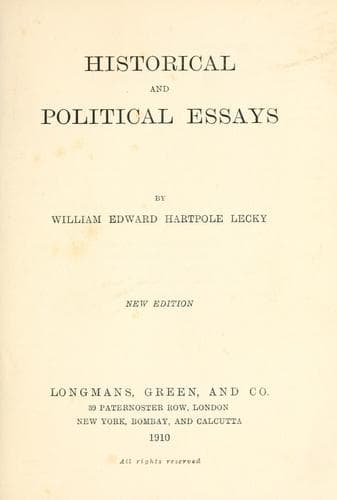
Historical and Political EssaysLecky, William Edward Hartpole
History
Historical and Political Essays
Lecky, William Edward Hartpole
History; Political science
But the influence of Grattan was now manifestly declining, and Peel
watched the decline with a short-sighted and not very generous
pleasure. In Parliament, though numbers were against the Catholics,
the overwhelming preponderance of ability was still in favour of the
principle of emancipation, and it was in leading the anti-Catholic
party that Peel chiefly acquired his almost unrivalled parliamentary
skill. He had, indeed, all the qualities of a great debater: courage,
fluency, self-possession, complete command of every subject he
treated, unfailing lucidity both in statement and reasoning; admirable
skill in marshalling and disentangling great masses of facts, in
meeting, evading, or retorting arguments, and detecting the weak
points of the case of an opponent, in veiling, by plausible language,
extreme or unpalatable views, in extricating himself by subtle
distinctions and qualifications from embarrassing situations. He can
scarcely, it is true, be called a great orator. His style was formal,
cumbrous, extremely verbose, without sparkle and without fire. He had
little or no power of moving the passions, nothing of the flexibility
that can adapt itself to very different audiences, nothing of the
philosophic insight that can impart a perennial interest to transient
discussions. But few men have ever understood the House of Commons
like him, or have possessed in so high a degree the qualities that are
most fitted to command and influence it. The great mass of
anti-Catholic sentiment in the country rallied around him as its most
powerful champion, and in 1817 he attained one of the chief objects of
his ambition in being elected member for Oxford University. It is well
known that his older and more brilliant rival had long aspired to this
honour. It was mainly through the Catholic question that Canning
missed and Peel won the prize.
The nickname 'Orange Peel,' which was given to him in Ireland, was
not wholly deserved. His letters abundantly show that he had no
sympathy with the ribbons, the anniversaries, the party tunes, the
insulting processions and insulting language of the Orangemen; and,
although he believed that in Ireland anti-Catholicism and loyalty were
very closely connected, he viewed with much dislike the growth of any
political confederacies unconnected with the Government. Declamation
and boastfulness and needless provocation were, indeed, wholly alien
to his nature; and even when defending extreme causes he rarely or
never used the language of a fanatic. He resisted Catholic concession
mainly on the ground that the admission of the Catholics to political
power would prove incompatible with the existence of the Established
Church in Ireland, with the security of property in a country where
property was mainly in Protestant hands, and ultimately with the
connection between the two countries. His arguments were not based on
religion, but on political expediency; but it was an expediency which
he believed to be permanent.
Public-domain text, read in full here on John Shaqi.
Reviews
Reviews
No reviews yet
Be the first to share your thoughts on this work.
Elsewhere in the archive
Join the Discussion
Join the discussion
Sign in to leave a comment or review.
Sign InorCreate an account