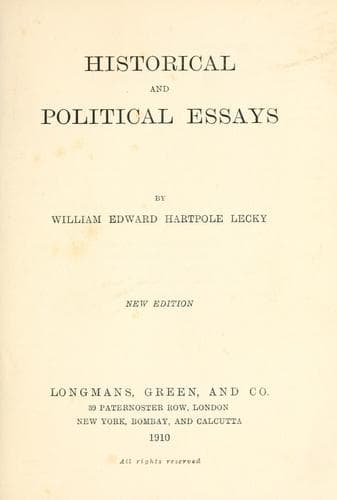
Historical and Political EssaysLecky, William Edward Hartpole
History
Historical and Political Essays
Lecky, William Edward Hartpole
History; Political science
'There is nothing so extraordinary,' he wrote, 'in natural history as
the longevity of all bishops, priests, and deacons in Ireland. During
the last five years there has been literally no Church preferment to
dispose of, to the infinite disappointment of many expectants.'
In the higher legal appointments, however, while insisting that
'attachment to the Government on principle' was very material, Peel
cordially agreed with Saurin that it was vitally necessary to select
men 'for character, and not for politics or connection'; and he added,
that those were not likely to be the least fit for high office who
were too proud to solicit it. 'It is a species of pride which
occasions very little practical inconvenience in Ireland.'
His letters show clearly the terrible evils of Irish life. He speaks
of 'the enormous and overgrown population,' with no employment except
agriculture; of a poverty so extreme that in many districts widespread
starvation was averted only by prompt Government intervention; of
'that infernal curse, the forty shilling freeholds'; of the evil
system of employing the military in distraining for rent and in the
collection of tithes; of juries, through fear or sympathy, acquitting
prisoners in the face of the clearest evidence; of the gross perjury
in the law courts; of the almost universal disaffection of the lower
orders, fostered by a seditious press; of the growing spirit of
animosity in the north of Ireland between the lower orders of
Protestants and Catholics, which was breaking out in constant riots,
and had already cost many lives. This last evil, it might be truly
said, was very largely due to the policy of his own party, who had
protracted through so many years the Catholic question, which ought
to have been settled at the Union. There was extreme and chronic
ignorance, poverty, and anarchy; the payment of tithes was constantly
resisted; and a failure of the potato crop, and a sudden and terrible
fall in the price of agricultural products after the peace, added
enormously to the difficulties of the situation. It is remarkable,
indeed, that there appears to have been in 1816 and 1817 less
disturbance of the public peace in Ireland than in England; Peel found
it even possible to reduce the military establishments, and in Dublin
extreme distress was borne with remarkable patience; but in many parts
of the country crimes of combination were frequent, and almost
incredibly savage. Peel mentions one case of a family of eight persons
who were deliberately burnt in their house by a party of armed men,
because the owner of the house had prosecuted to conviction three men,
on a capital charge, at the Louth assizes. In another case a farmer,
who had shot two men who attacked his house, was himself shot dead on
a Sunday morning, after Mass, at the chapel door, in the presence of
hundreds of men, not one of whom attempted to arrest the culprit.
Public-domain text, read in full here on John Shaqi.
Reviews
Reviews
No reviews yet
Be the first to share your thoughts on this work.
Elsewhere in the archive
Join the Discussion
Join the discussion
Sign in to leave a comment or review.
Sign InorCreate an account