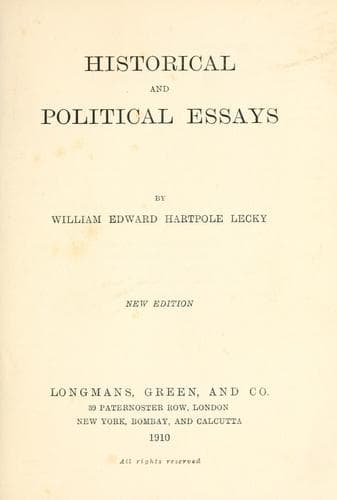
Historical and Political EssaysLecky, William Edward Hartpole
History
Historical and Political Essays
Lecky, William Edward Hartpole
History; Political science
The election of 1826 virtually carried Catholic emancipation, for it
reduced Ireland to a state in which it was impossible long to resist
it. Clear-sighted men had no difficulty in perceiving that the policy
of Peel had failed to avert it, though it had succeeded in making
impossible the securities which Grattan and the wisest men of his
generation had pronounced indispensable for its safe working, in
kindling religious hatreds as intense as in the darkest period of the
eighteenth century, in breaking down that healthy relation and
subordination of classes on which beyond all other things the future
well-being of Ireland depended. Peel was not wholly blind to what was
happening. 'A darker cloud than ever,' he wrote, 'seems to me to
impend over Ireland, that is if one of the remaining bonds of society,
the friendly connection between landlord and tenant, is
dissolved.'[40] He still persuaded himself, however, that the
political power of the priests was transient, and that a reaction
would set in that might destroy it. The defeat of the Catholic
question in the new Parliament by a majority of four encouraged him in
his resistance. In January 1827 the death of the Duke of York removed
one serious obstacle to the Catholic cause, and six weeks later Lord
Liverpool, who had so long held together the divided Ministry, was
struck down by apoplexy. Peel would gladly have continued in his
present position if a peer of real weight who held his opinions on the
Catholic question was appointed to the vacant place. But there was no
such peer, except Wellington, to be found, and under Wellington
Canning refused to serve. Canning had, indeed, now fully resolved to
be at the head of the Administration, and Peel refused to serve under
him.
With his opinions on the Catholic question it is impossible to blame
him, and the letters which passed between the two statesmen are very
honourable to both, and show clearly that in spite of great divergence
of opinion, character, and interests, each could recognise the good
faith of the other. In a letter written to one of his brothers Peel
describes his position with complete frankness:
'I am content with my position in the Government, and willing to
retain it--willing to see Mr. Canning leader of the House of Commons,
as he has been. But giving him credit for honesty and sincerity, if he
is at the head of the Government, and has all the patronage of the
Government, he must exert himself as an honest man to carry the
Catholic question; and to the carrying of that question, to the
preparation for its being carried, I never can be a party. Still less
can I be a party to it for the sake of office.'
These words were written little more than a year before Peel
undertook, as Minister of the Crown, to introduce a measure of
Catholic emancipation. But if they do little credit to his prescience,
no one can mistake the accent of sincerity in what follows:
Public-domain text, read in full here on John Shaqi.
Reviews
Reviews
No reviews yet
Be the first to share your thoughts on this work.
Elsewhere in the archive
Join the Discussion
Join the discussion
Sign in to leave a comment or review.
Sign InorCreate an account