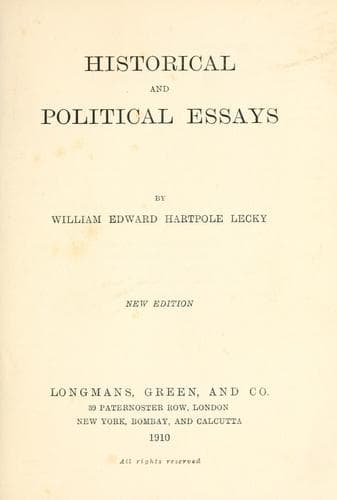
Historical and Political EssaysLecky, William Edward Hartpole
History
Historical and Political Essays
Lecky, William Edward Hartpole
History; Political science
Edward Henry, fifteenth Earl of Derby, was born July 21, 1826, and was
educated at Rugby, and Trinity College, Cambridge, where he obtained a
First Class in classics. In March 1848 he unsuccessfully contested
Lancaster, and soon after started for a long and instructive journey
in America and the West Indies. During his absence from England he was
elected Member for Lynn Regis upon the death of Lord George Bentinck
in September 1848, and he held this seat without interruption till his
accession to the earldom in October 1869. His first speech in the
House of Commons was delivered on May 31, 1850, on the sugar duties.
The effect on the West Indies of the abolition of the preferential
duty on sugar was a subject which he had specially studied during his
journey, and he had published a pamphlet upon it. Sir Robert Peel
greatly praised his maiden speech, and Greville describes the great
impression which it made--an impression which a further knowledge of
the speaker speedily confirmed.
The appearance in Parliament of the eldest son of one of the most
brilliant party leaders of the age could scarcely fail to be a
considerable political event, and it was soon found that the new
member was not only a man of rare ability, but was also in nearly all
respects very unlike his illustrious father. Never was there a more
striking instance of that strange freak of heredity by which an able
son is sometimes much less the continuation than the complement of an
able father, exhibiting in strongly contrasted lights both opposite
qualities and opposite defects. The fourteenth Earl was a great
orator. He was one of the greatest debaters who have ever lived. He
was a party leader of extraordinary power, delighting in political
conflict; throwing into it much of the fire and passion which he
displayed in his sporting contests; little fitted to conciliate
opponents, but eminently fitted to win the enthusiastic loyalty of his
followers, to rally a dispirited minority, to lead a party attack. His
keen and rapid judgment; his perfect command of pure and lucid
English; his unfailing readiness in argument, invective, sarcasm, and
repartee; his indomitable courage, and the somewhat imperious dignity
of his manner, all marked him out for the position which he held. If
there was some truth in the common taunt that he was more a party
leader than a statesman, it must at least be remembered that he has
identified his name with several important measures, and that during
most of his career he was in a hopeless minority. His enemies accused
him of rashness, arrogance, and some superficiality, both of thought
and knowledge. They alleged that he carried too much of the sporting
spirit into politics; that his naturally excellent judgment was often
deflected by the passions of the fray; that he was accustomed to
judge measures more by their party advantages than by their intrinsic
merits, and to care more for an immediate triumph than for ultimate
results.
Public-domain text, read in full here on John Shaqi.
Reviews
Reviews
No reviews yet
Be the first to share your thoughts on this work.
Elsewhere in the archive
Join the Discussion
Join the discussion
Sign in to leave a comment or review.
Sign InorCreate an account