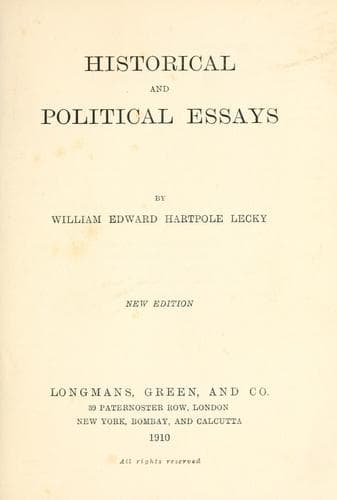
Historical and Political EssaysLecky, William Edward Hartpole
History
Historical and Political Essays
Lecky, William Edward Hartpole
History; Political science
It was not difficult to forecast the place which a statesman of this
kind was likely to fill in English politics. He was plainly wanting in
many of the qualities of a party leader, and in most of the qualities
of a parliamentary gladiator, and he was not likely to succeed in all
forms of statesmanship. He would certainly not prove
A daring pilot in extremity,
Pleased with the danger when the waves went high.
His clear perception of the objections to any course, combined with a
very deep sense of responsibility, not unfrequently enfeebled his will
in moments when bold and decisive action was required, and there were
times when the love of compromise which was so useful an element in
his character seemed to his best friends too closely allied to
weakness. But he probably saved every party with which he acted from
many mistakes. He brought to every Government which he joined a very
eminent administrative capacity. He defended every policy that he
espoused with a persuasive reasoning that few men could equal. He was
a supremely skilful detector of false weights and of false measures.
Every fad, every new-born enthusiasm, every crude ill-digested theory,
found in him the calmest and most penetrating of critics, and he
inspired the great body of moderate men of all parties with a deep
confidence in his patriotism and in his judgment.
His political position was marked out by the fact that his father had
recently broken away from the Whig connection which had hitherto been
that of his family, and was now the leader of the Conservative party.
The son naturally took his place under his father's banner, but I much
question whether he would have done so if no family influence had
interfered. It was not that he at any time changed considerably his
views. As Macaulay has truly said--while the extremes of the two
English parties are separated by a wide chasm, there is a frontier
line where they almost blend; and Lord Derby when a Conservative
always represented the Liberal, and when a Liberal the Conservative
wing of his party. But his mind had much of the Whig character; his
judgment was very independent; and on Church questions especially he
was never fully in harmony with his party. He was appointed
Under-Secretary of State for Foreign Affairs in his father's first
short Ministry in March 1852, at a time when he was travelling in
India, and he left office with his father in December of the same
year. In 1853 he made a remarkable speech on Indian affairs, in some
degree foreshadowing the Indian policy which he was afterwards
destined to take such a large part in carrying into effect. During the
next few years he spoke frequently on Indian and Colonial questions,
on questions connected with education, factories, and other
working-class interests, and he supported--often in opposition to the
majority of his party--a large number of reforms which have since been
accomplished. He advocated the introduction of competitive
Public-domain text, read in full here on John Shaqi.
Reviews
Reviews
No reviews yet
Be the first to share your thoughts on this work.
Elsewhere in the archive
Join the Discussion
Join the discussion
Sign in to leave a comment or review.
Sign InorCreate an account