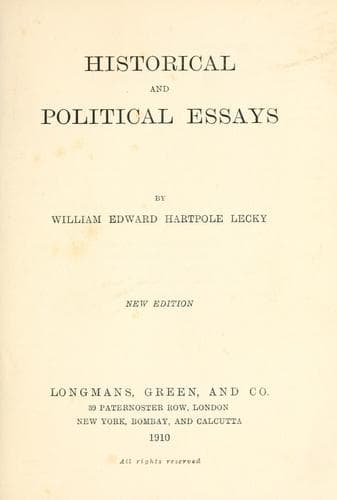
Historical and Political EssaysLecky, William Edward Hartpole
History
Historical and Political Essays
Lecky, William Edward Hartpole
History; Political science
Lord Stanley had not long to wait for high office. His father formed
his second Administration in February 1858, and Lord Stanley was made
Colonial Secretary. He appears to have accepted the office with some
reluctance, and only because Sir E. Bulwer, for whom it was at first
intended, found that he could not secure his re-election. The
Government was a very weak one, and it opened with the worst
prospects. It was a Government in a minority. Its very existence
depended on the dissensions between Lord Palmerston and Lord John
Russell, and its first steps met with little favour either in the
House or in the country. The Indian Mutiny was now nearly suppressed,
and Lord Palmerston shortly before quitting office had pledged the
House of Commons to the policy of withdrawing the Government of India
from the East India Company and placing it directly under the Crown.
To carry this policy into effect was the first task of the new
Government. They introduced an Indian Bill which they were compelled
to withdraw, and then substituted for it a new Bill founded on
resolutions which were carried through the House of Commons. In May
the Government almost fell on account of the indiscreet publication of
a despatch of Lord Ellenborough, condemning a Proclamation of the
Governor-General, Lord Canning. A vote of censure was moved and would
certainly have been carried if Lord Ellenborough had not saved his
colleagues by resigning. He was President of the Board of Control, the
Office which then directed Indian affairs, and Lord Stanley took his
place, piloted the Indian Bill successfully through the House of
Commons, and when the measure became law, was the first Secretary of
State for India, and undertook the very important and responsible task
of beginning the new system of Indian Government.
Public-domain text, read in full here on John Shaqi.
Reviews
Reviews
No reviews yet
Be the first to share your thoughts on this work.
Elsewhere in the archive
Join the Discussion
Join the discussion
Sign in to leave a comment or review.
Sign InorCreate an account