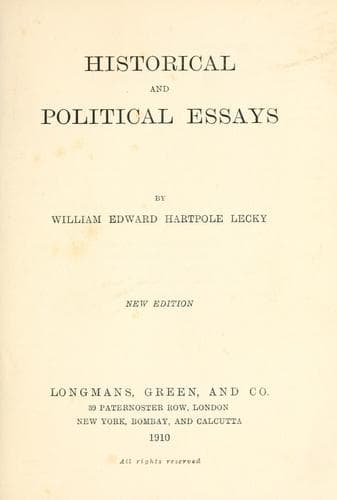
Historical and Political EssaysLecky, William Edward Hartpole
History
Historical and Political Essays
Lecky, William Edward Hartpole
History; Political science
The election of 1874, bringing the Conservative party again into
power, called him to other fields, and he became for the second time
Foreign Secretary under Disraeli, and was soon involved in that
Eastern Question which led to his severance from the Conservative
party. It would answer no good purpose in a short sketch like the
present to rake up the still smouldering ashes of that controversy.
The time will come when it will be reviewed in the calm light of
history, and with the assistance of materials that are not now before
the public. I shall here content myself with a mere sketch. In the
earlier stages of their foreign policy the Government appear to have
been perfectly agreed. Lord Derby fully concurred in the purchase of
the Khedive's shares in the Suez Canal, which was one of the most
successful strokes of policy of the Government, though he defended it
on somewhat more prosaic grounds than some of its supporters, and was
careful to explain that it was essentially a measure of self-defence,
and not connected with any project for the dismemberment of Turkey or
the establishment of an English protectorate in Egypt. When the
insurrection broke out in 1875 in Herzegovina and Bosnia, neither Lord
Derby nor any of his colleagues believed it to be more than a mere
passing disturbance. But the feebleness manifested by the Turkish army
in suppressing the insurrection, and the partial bankruptcy of the
Government at Constantinople, contributed with many elements of race
and religious dissension, with foreign intrigue and local
misgovernment, to aggravate the sore, and the movement soon acquired
the dimensions of a great European danger. In sending an English
Consul in conjunction with the Consuls of the other Powers to the
scene of insurrection, in order, if possible, to arrive at a
mediation; in the acceptance of the Andrassy Note, by which the three
Imperial Powers laid down the reforms which they considered urgently
necessary; in the rejection of the Berlin Memorandum, on the ground
that the Porte could not or would not carry out its demands, and that
it would almost certainly lead to an armed intervention; and finally,
in sending the British fleet to Besika Bay for the purpose of
protecting English and Christian interests at Constantinople, at a
time when that city was in a state of almost complete anarchy, the
Government were fully agreed, and they carried with them an immense
majority in Parliament and in the country. For some time, also, the
country seemed to approve of the policy which Lord Derby uniformly
avowed and steadily observed, of maintaining a strict neutrality in
the contest that was raging; doing all that could be done by advice,
remonstrance, mediation, and moral influence to induce the Porte to
carry out internal reforms; warning the Turkish Government in clear
terms that under the circumstances of the case they must not look for
any military assistance from England, but at the same time
Public-domain text, read in full here on John Shaqi.
Reviews
Reviews
No reviews yet
Be the first to share your thoughts on this work.
Elsewhere in the archive
Join the Discussion
Join the discussion
Sign in to leave a comment or review.
Sign InorCreate an account