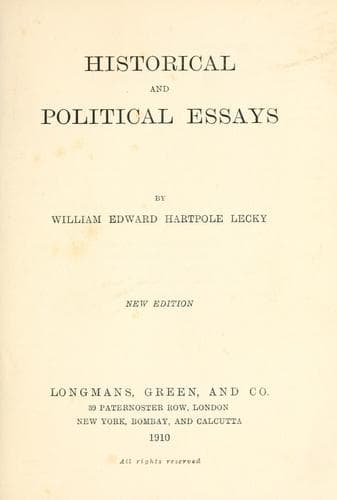
Historical and Political EssaysLecky, William Edward Hartpole
History
Historical and Political Essays
Lecky, William Edward Hartpole
History; Political science
The foregoing sketch will, I hope, have given a sufficient idea of his
public character. Few men have made a greater sacrifice of ambition to
a conscientious conviction than he did, when, rather than support a
measure which might lead to war, he abandoned the Conservative
Ministry in 1878. He was then the fully recognised successor of Lord
Beaconsfield, and if he had adopted a different course he would in a
short time have been, beyond all doubt, Prime Minister of England. On
the whole, however, the severance from old friends cost him, I
believe, far more than the sacrifice of his political prospects.
Whatever he may have been in his youth, he was certainly not in mature
life an ambitious man. With the great position he held in England the
world had little to offer him, and the self-knowledge which was not
the least of his many remarkable gifts showed him that party conflict
was not the sphere in which Nature intended him to move. With many of
the qualities of the highest statesmanship he wanted some necessary
ingredients of a great statesman. He wanted the power of appealing to
the imagination and moving the passions. He wanted more decision of
character, more power of initiative, more capacity of bearing lightly
the weight of a great responsibility. His belief that the House of
Lords must always ultimately yield to the House of Commons aggravated
a weakness of resolution which was deeply rooted in his nature. There
were moments when his inveterate moderation tended to exasperate, and
he was accused, not altogether without reason, of sometimes making
admirable speeches, pointing out in the clearest terms all the evils
and dangers of a measure, and then concluding by exhorting the House
of Lords to vote for it, introducing mitigating amendments in
Committee. The measures he treated in this way usually, as he had
predicted, became law, but this was not the attitude of a great
leader. During a considerable part of his career, like a very large
proportion of moderate men in England, he was in the embarrassing
position of agreeing substantially with the home policy of one party
and with the foreign policy of the other. After the death of Lord
Palmerston an element of passion was infused into public life which
was very uncongenial to his temperament, and English politics passed
into phases in which caution, character, judgment, and knowledge were
less prized than brilliant strokes that appealed to the popular
imagination, clever coalitions, a skilful barter of principles for
votes. In spheres governed by such methods Lord Derby was very useful,
but he was not likely to play a foremost part.
Public-domain text, read in full here on John Shaqi.
Reviews
Reviews
No reviews yet
Be the first to share your thoughts on this work.
Elsewhere in the archive
Join the Discussion
Join the discussion
Sign in to leave a comment or review.
Sign InorCreate an account