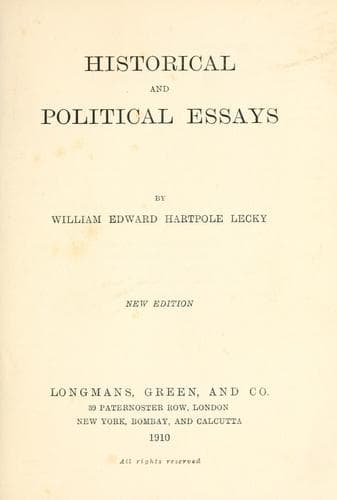
Historical and Political EssaysLecky, William Edward Hartpole
History
Historical and Political Essays
Lecky, William Edward Hartpole
History; Political science
In prose his pen was exceedingly active. In 1820 he began his long
connection with the 'Quarterly Review,' which continued, with
occasional intervals, through more than forty years. His articles
extended over a great variety of subjects, but most of them were
essentially reviews and essentially critical. The fact that he was
both a poet and an accomplished critic of verse caused some persons to
ascribe to him the authorship of two articles which had an unhappy
reputation--the criticism which was falsely supposed to have hastened
the death of Keats, and the attack upon the 'Alastor' of Shelley, a
poet for whom Milman had a special admiration. It is now well known
that neither of these articles was by him, but it is characteristic of
his loyalty to his colleagues that he never disclaimed the authorship.
This loyalty was indeed not less conspicuous in his nature than the
singular kindness of disposition with which he ever shrank from giving
pain. After his death a few of his many essays in the 'Quarterly' were
collected in one volume. Among them there is an admirable account of
Erasmus, with whom in mental characteristics he had considerable
affinity.
In 1829 appeared his first historical work, the 'History of the Jews,'
a work which excited a violent storm of theological indignation. The
crime of Milman was that he applied to Jewish history the usual canons
of historical criticism--sifting evidence, discriminating between
documents, pointing out the parallelisms between Jewish conditions and
those of other Oriental nations, and attempting to separate in the
sacred writings the parts which were essential and revealed from those
which were merely human and fallible. In a remarkable preface to a
revised and enlarged edition of this work, which was published thirty
years later, he laid down very clearly the principles that had guided
him. The Jewish writers, in his opinion, were 'men of their age and
country who, as they spoke the language, so they thought the thoughts
of their nation and their time.... They had no special knowledge on
any subject but moral and religious truth to distinguish them from
other men, and were as fallible as others on all questions of science,
and even of history, extraneous to their religious teaching.... Their
one paramount object being instruction and enlightenment in religion,
they left their hearers uninstructed and unenlightened as before in
other things.... In all other respects society, civilisation,
developed itself according to its usual laws. The Hebrew in the
wilderness, excepting as far as the law modified his manners and
habits, was an Arab of the desert. Abraham, except in his worship and
intercourse with the one true God, was a nomad Sheik.... The moral and
religious truth, and this alone, I apprehend, is "the word of God"
contained in the sacred writings.'
Public-domain text, read in full here on John Shaqi.
Reviews
Reviews
No reviews yet
Be the first to share your thoughts on this work.
Elsewhere in the archive
Join the Discussion
Join the discussion
Sign in to leave a comment or review.
Sign InorCreate an account