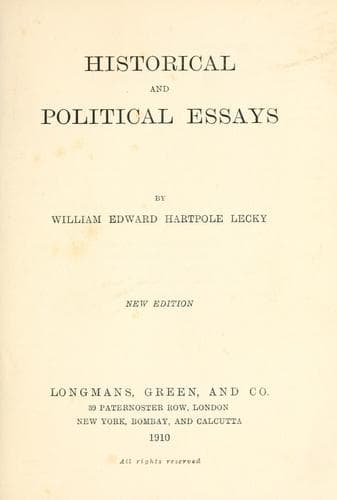
Historical and Political EssaysLecky, William Edward Hartpole
History
Historical and Political Essays
Lecky, William Edward Hartpole
History; Political science
But great numbers of what were deemed miracles may be explained by
natural causes, by figurative modes of expression which were common in
Oriental nations, by the tendency of the human mind to embellish or
exaggerate surprising facts, or invent supernatural causes for what it
is unable to explain, by the retrospective imagination which seeks to
dignify the distant past with a supernatural halo. The early annals of
all nations are strewn with pretended miracles which no one will now
maintain, and Milman shows in a powerful passage how the idea of the
miraculous has been steadily contracting and receding; how dangerous
it is to base the defence of Christianity on the evidence of miracles
rather than on appeals to the conscience, the moral sense, the innate
religiousness, the deep spiritual cravings of human nature.
Such views, though now sufficiently commonplace, seemed very novel in
England when Milman wrote. Dean Stanley described his work as 'the
first decisive inroad of German theology into England; the first
palpable indication that the Bible could be studied like another book;
that the characters and events of sacred history could be treated at
once critically and reverently.' But though Milman was very well
acquainted with German theology, he resented the notion that he was
its interpreter or representative. He contended that in restricting
the province of inspiration to the direct inculcation of religious
truth he was following a sound Anglican tradition. He quoted the
authority of Paley and Warburton, of Tillotson and Secker. In such
principles of interpretation he said he had found 'a safeguard during
a long and not unreflective life against the difficulties arising out
of the philosophical and historical researches of his time.' They had
enabled him 'to follow out all the marvellous discoveries of science,
and all those hardly less marvellous, if less certain, conclusions of
historical, ethnological, linguistic criticism, in the serene
confidence that they are utterly irrelevant to the truth of
Christianity.' 'If on such subjects,' he concluded, 'some solid ground
be not found on which highly educated, reflective, reading, reasoning
men may find firm footing, I can foresee nothing but a wide, a
widening--I fear, an irreparable--breach between the thought and the
religion of England. A comprehensive, all-embracing, truly Catholic
Christianity which knows what is essential to religion, what is
temporary and extraneous to it, may defy the world.'
Public-domain text, read in full here on John Shaqi.
Reviews
Reviews
No reviews yet
Be the first to share your thoughts on this work.
Elsewhere in the archive
Join the Discussion
Join the discussion
Sign in to leave a comment or review.
Sign InorCreate an account