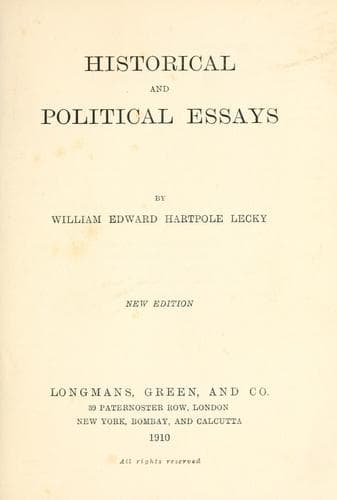
Historical and Political EssaysLecky, William Edward Hartpole
History
Historical and Political Essays
Lecky, William Edward Hartpole
History; Political science
'I only wish,' wrote Milman, when the fact was brought to his notice,
'all Carlisle's customers would read it. A noble lord once wrote to
the bishop of a certain diocese to complain that a baronet who lived
in the same parish brought his mistress to church, which sorely
shocked his regular family. The bishop gravely assured him that he was
very glad to hear that Sir ---- brought his naughty lady to church,
and hoped that she would profit by what she heard there and amend her
ways. So say I of Carlisle's customers.'[50]
The opinions expressed in this, as in his later works, no doubt in
some degree obstructed the promotion of Milman in the Church, but he
had no reason to regret it. Of all men, he once said, he thought he
owed most to Bishop Blomfield, for there was once a question of
offering him a bishopric, and it was a remonstrance of the Bishop of
London that prevented it. 'I am _afraid_,' he said, 'that if it had
been offered me I should have accepted it, and I should then never
have written my "Latin Christianity."' But, though he escaped the fate
which has cut short the best work of more than one distinguished
historian, his conspicuous position among the scholars and writers in
the Church was widely recognised, and he was soon transferred from a
provincial town to a central position in the Metropolis. In 1835 Sir
Robert Peel made him Rector of St. Margaret's, Westminster, and
Prebendary in the Abbey. Though continuing without intermission his
historical work, he appears to have discharged with exemplary vigour
the duties of a large and poor parish until 1849, when Lord John
Russell appointed him Dean of St. Paul's. The position was exactly
suited to him. It was one of much dignity, but also of much leisure,
and it gave him ample opportunities of pursuing the studies which were
the true work of his life.
The great subject of the history of Christianity was, indeed,
continually before him. Among other things, he studied minutely both
the text and the authorities of Gibbon, for whom he had a deep and
growing admiration. An excellent edition of Gibbon was one of the
first results. Milman's notes have been included in Smith's later
edition, and, though a large proportion of them were naturally
somewhat controversial, being devoted to refuting some of the
conclusions of the fifteenth and sixteenth chapters, it is impossible
to read them without recognising the candour as well as the learning
and the acumen of the critic. Few things that Milman has written are
finer than the preface in which, in ten or twelve masterly pages, he
sums up his estimate of his great predecessor.
Public-domain text, read in full here on John Shaqi.
Reviews
Reviews
No reviews yet
Be the first to share your thoughts on this work.
Elsewhere in the archive
Join the Discussion
Join the discussion
Sign in to leave a comment or review.
Sign InorCreate an account