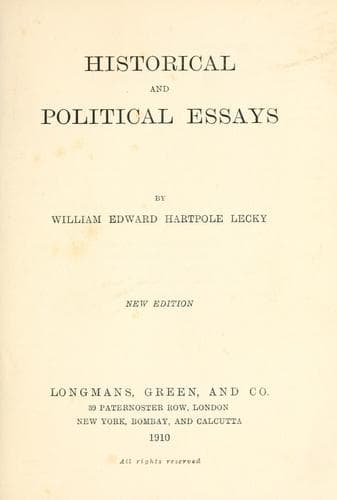
Historical and Political EssaysLecky, William Edward Hartpole
History
Historical and Political Essays
Lecky, William Edward Hartpole
History; Political science
On other occasions her remonstrances were disregarded, and courses
were pursued to which she strongly objected. The surrender after
Majuba was in her opinion a pusillanimous abandonment of the English
flag, and it was with extreme reluctance that she acquiesced in it.
Still more vehement were her feelings about the long abandonment of
General Gordon in the Soudan. She had been indefatigable in urging on
the Ministry of Gladstone the duty of speedy measures for his rescue,
and when, owing to the long delay of the Ministry, the most heroic of
modern Englishmen perished at Khartoum, her indignation knew no
bounds. In a letter to his sisters, burning with mingled pity and
indignation, she pronounced his 'cruel though heroic fate' to be 'a
stain left upon England,' which she keenly felt. This was one of the
few occasions in which she allowed her sentiments in hostility to the
policy of her Ministers to appear publicly before the world. In
general, she had a profound distrust of the policy and judgment of Mr.
Gladstone, and she fully shared the dread with which the great body of
English statesmen looked upon the Home Rule policy. It was no new
sentiment on her part, for she had lived through the Repeal agitation
of O'Connell, and as far back as 1843 Sir Robert Peel had somewhat
unconstitutionally declared in Parliament that he was authorised by
the Queen to state that she, like her predecessor, was resolved to
maintain the Union inviolate by all the means in her power.
There can now be no harm in saying--what when both parties were alive
was naturally kept in the background--that the relations of the Queen
with Mr. Gladstone were usually of a very painful character. She had
personally not much to complain of. The skill and firmness with which
Mr. Gladstone resisted the attempts to diminish the parliamentary
subsidies for her family were fully and gratefully recognised by the
Queen, but the main course of his politics, both foreign and domestic,
filled her with alarm, and she never appears to have experienced the
attraction which his great personal gifts exercised over most of those
with whom he came in immediate contact. The extreme copiousness of his
vocabulary, the extreme subtlety of his mind and reasoning, and the
imperiousness of temper with which he seldom failed to meet
opposition, were all repugnant to her. To those who have experienced
the sustained emphasis of language with which Mr. Gladstone was
accustomed in conversation to enforce his views, there is much truth
as well as humour in the saying which was attributed to the Queen, 'I
wish Mr. Gladstone would not always speak to me as if I was a public
meeting'; and a little episode which is related by Sir Theodore Martin
illustrates the irritation which Mr. Gladstone's methods of business
must have caused to a very busy and overworked lady who always loved
few words and simple and direct arguments.[53] At all times the Queen
Public-domain text, read in full here on John Shaqi.
Reviews
Reviews
No reviews yet
Be the first to share your thoughts on this work.
Elsewhere in the archive
Join the Discussion
Join the discussion
Sign in to leave a comment or review.
Sign InorCreate an account