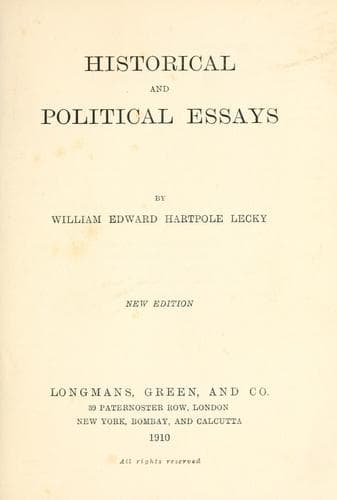
Historical and Political EssaysLecky, William Edward Hartpole
History
Historical and Political Essays
Lecky, William Edward Hartpole
History; Political science
There were occasions when she took independent steps, and some of these
had a considerable influence on politics. Louis Napoleon was one of the
few great Sovereigns who were not related to her, and to few persons
could the _coup d'état_ which brought him to the throne have been more
repugnant, but the cordial personal relations she established with him
undoubtedly contributed considerably to the good relations which for
many years subsisted between England and France. Bismarck detested
English Court influence and was greatly prejudiced against her, but he
has left a striking testimony to the favourable impression which her
tact and good sense made upon him when he first came into contact with
her. She possessed to a high degree the power of choosing the right
moment and striking the true chord, and she appears to have been an
excellent judge not only of the feelings of large bodies of men, but
also of the individual characters of those with whom she dealt. She had
a style of writing which was eminently characteristic and eminently
feminine, and it is easy to trace the letters which were entirely her
own. Her letters of congratulation, or sympathy, or encouragement on
public occasions scarcely ever failed in their effect and never
contained an injudicious word. The same thing may be said of her many
beautiful letters to those who were suffering from some grievous
calamity. Whether she was writing to a great public character like the
widow of an American President, or expressing her sorrow for obscure
sufferers, there was the same note of true womanly sympathy, so
manifestly spontaneous and so manifestly heartfelt, that it found its
way to the hearts of thousands. The tact for which she was so justly
celebrated, like all true tact, sprang largely from character, from the
quick and lively sympathies of an eminently affectionate nature. No one
could have been less theatrical, or less likely in any unworthy way to
seek for popularity; but she knew admirably the occasions or the methods
by which she could strike the imagination and appeal most favourably to
the feelings of her people. She showed this in the very beginning of her
reign when she insisted, in defiance of the opinion of the Duke of
Wellington, on riding herself through the ranks of her troops at her
first review. She showed it on countless other occasions of her long
reign--pre-eminently in her two Jubilees and in her last visit to
Ireland. It is well known that this visit was entirely her own idea. To
many it seemed rash or even positively dangerous. They dwelt upon the
bitter disaffection of a great portion of the Irish people, upon the
danger of mob outrage or even assassination, upon the extreme difficulty
of preventing a royal visit to Ireland from taking a party character and
being regarded as a party triumph or defeat. But the Queen, as Sir
William Harcourt once truly said, 'never feared her people,' and nothing
Public-domain text, read in full here on John Shaqi.
Reviews
Reviews
No reviews yet
Be the first to share your thoughts on this work.
Elsewhere in the archive
Join the Discussion
Join the discussion
Sign in to leave a comment or review.
Sign InorCreate an account