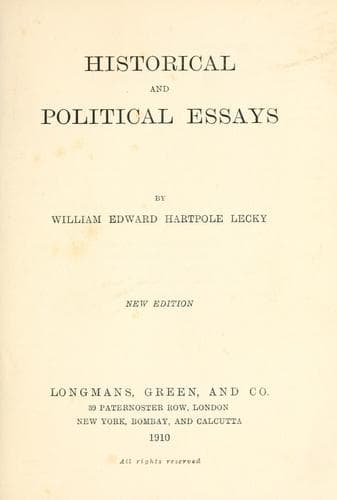
Historical and Political EssaysLecky, William Edward Hartpole
History
Historical and Political Essays
Lecky, William Edward Hartpole
History; Political science
I cannot conclude without protesting against the supposition that
those who think with me are indifferent to the great evil of old-age
destitution and propose nothing for its relief. The committees which
have most clearly pointed out the dangers of old-age pensions have
also urged, that within the lines of our present poor-law system it is
quite possible to do much, by an improved classification, to
distinguish among the recipients of poor-law relief between the
respectable and the worthless. Much has already been done, and in the
most important unions the guardians have introduced a large amount of
classification by merit. As I have already said, the immense majority
of the respectable aged poor are now relieved only in their own homes
or in comfortable infirmaries. The severe test of absolute destitution
has in practice been greatly relaxed; there is a legal provision
preventing those who are receiving help from Friendly Societies from
being disqualified for relief; husbands and wives are no longer
separated in the workhouse; and in some unions of which we had
evidence much more has been done. This, however, depends too much on
the will of particular Boards of Guardians, and there are in
consequence great inequalities of treatment. The condition of the
deserving poor may be greatly improved by relaxation in points of
hours, discipline, and visitors, and by workhouse arrangements
securing more universally that paupers who have lived respectable
lives should not be obliged to mix with the drunken, the disreputable,
and the hopelessly idle. And, though extensions of outdoor relief
should be carefully watched, and entail great dangers, yet under wise
and strict administration something more may be done in this
direction.
But all this should be regarded as essentially poor-law relief, and
not as the recognition of a claim of right for services supposed to
have been rendered to the community. No form of State Socialism is
more dangerous than the doctrine which has been countenanced by Prince
Bismarck, and which is making many disciples in England--namely, that
an industrious man, who has pursued his course in life with perfect
independence, made his own contracts, chosen his own work, and been
paid for it by stipulated wages, is entitled, if he fails in obtaining
a sufficiency for his old age, to be placed as a 'soldier of industry'
in the same category as State servants, and to receive like them, not
on the ground of compassion, but of right, a State pension drawn from
the taxation of the community. There is no real analogy between the
relief that is very properly granted to such workmen in their
destitution, and the pensions--largely of the nature of deferred
pay--that are given by the State or by private employers, under the
terms of distinct contracts, and for specific services duly rendered,
to those who have entered into their employment and placed themselves
under their control.
INDEX
Aberdare Commission, 303
Addington, 273
Public-domain text, read in full here on John Shaqi.
Reviews
Reviews
No reviews yet
Be the first to share your thoughts on this work.
Elsewhere in the archive
Join the Discussion
Join the discussion
Sign in to leave a comment or review.
Sign InorCreate an account